Pistol Shooting Stance: Balance, Grip, and Shot Control
13.10.2026Author: Charles Darwin
Accuracy when shooting a pistol depends on more than just trigger control. A stable body position, proper grip, and recoil control all help maintain stability. In this article, we’ll break down the basic stances, common mistakes, and the benefits of training with an instructor.
Your shooting stance is the foundation that determines the accuracy, speed, and stability of your shots. It’s a serious mistake to assume that accuracy depends solely on smoothly pulling the trigger. If you don’t learn how to distribute your body weight correctly, hold the gun properly, and control recoil, you won’t be able to shoot effectively.
In this article, we’ll explore how to hold a pistol correctly, which stance and grip are best for beginner shooters, and why it’s better to practice precision shooting right away at the range.
Why Stance and Grip Determine Accuracy and Safety
Accuracy isn’t just about of the dominant eye while shooting, or aligning the front sight with the target, but also the ability to hold the firearm steady while pulling the trigger and return it to the line of sight after firing.
Stability is of paramount importance. With the correct stance, the shooter can control their center of gravity, allowing their body weight to act as a sort of shock absorber. An incorrect stance causes the recoil from each shot to “knock back” the shooter’s body and throw off their aim. In addition, the correct alignment of bones and joints reduces the strain on the muscles. Without muscle strain, hand tremors will be reduced, which also affects aim.
The grip helps keep the pistol in the correct position and allows the index finger to move independently of the other fingers. Simply put, when the pistol is held steadily, the finger can smoothly pull the trigger without causing any sudden movements of the weapon. With a weak grip, the entire hand may involuntarily tense up when pulling the trigger, causing the barrel to shift to the side. The grip helps control muzzle rise. And after the shot, a stable wrist position will automatically return the pistol to its original aiming point.
As for safety when using a firearm, it is also entirely controlled by proper grip and stance. First, the grip prevents accidental discharges during recoil and also protects against injury (holding the pistol incorrectly can result in painful cuts from the slide moving backward).
Second, proper stance determines the direction of the barrel. If the stance is incorrect, the shooter loses balance, and their arms and body will shift to compensate, leading to a violation of key safety rules.
Basic Body Position and Balance Before Firing
Proper basic body position and balance ensure stability, recoil control, and the pistol’s return to the line of sight. To achieve this, it is important to pay attention to your feet, weight distribution, torso, and shoulders. It is also essential to understand the dominant eye when shooting — this is another fundamental factor for achieving accuracy.
Feet, Knees, and Weight Distribution
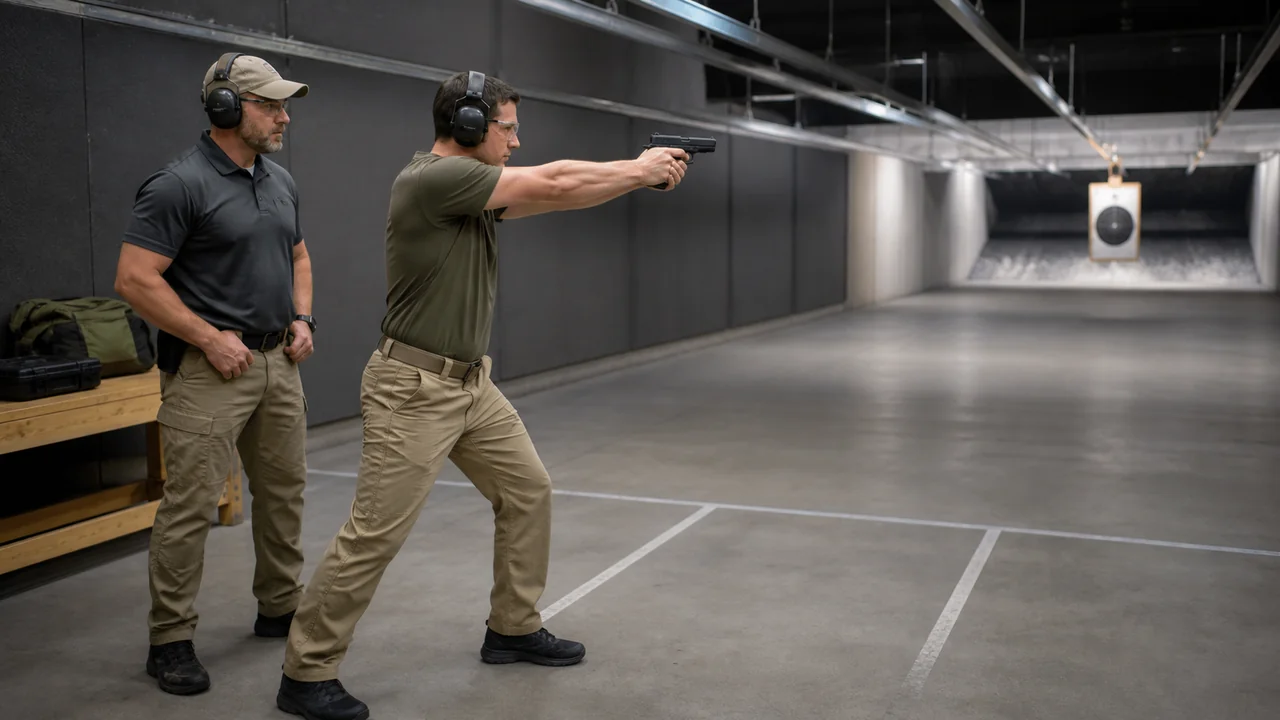
Position your feet and feet shoulder-width apart or slightly wider. If your stance is too narrow, you will lack lateral stability; if it is too wide, the shooter’s mobility is reduced. The supporting foot should be positioned forward, with the toe pointing directly at the target. The foot of the supporting leg may be turned slightly outward so that the joints are comfortable. The feet should be flat on the ground, without shifting weight to the outer or inner sides of the feet.
The knees are slightly bent but not overly strained. This allows them to act as shock absorbers, dampening the recoil impulse, maintaining balance for rapid follow-up shots, and preventing the spine from shifting.
Shift your center of gravity by transferring 60–70% of your body weight to the balls of your feet, without lifting your heels. Lean your torso slightly forward, toward the target. This helps compensate for the weight of your outstretched arms and the force of recoil, preventing you from being thrown backward when you fire. As for balance, distribute your body weight evenly between your right and left legs to maintain stability in all planes.
It’s easy to test for proper balance: if someone gently pushes the shooter from the front at the muzzle, the shooter should not lose their balance. The body should form a rigid, yet relaxed, and unified structure.
Torso, Shoulders, and Forward Lean
When shooting a pistol, the shoulders are lowered and relaxed, but they should be brought slightly forward toward the target. Raising the shoulders toward the ears is strictly prohibited, as this will lead to neck muscle strain and impaired blood flow, which will interfere with applying smooth pressure to the trigger. In addition, bringing the shoulder girdle forward creates a solid, stable frame with the arms and the pistol, which absorbs the recoil from the shot.
Your overall body balance should be slightly forward-leaning, but without excessive tension in the body. The core and leg muscles should be engaged to maintain the necessary balance, while the upper shoulder girdle remains mobile to minimize micro-vibrations when firing the pistol.
How to Hold a Pistol Correctly with Both Hands
Beginner shooters often believe that with a two-handed grip, the dominant hand does most of the work, while the other hand merely supports the pistol. In practice, both hands work together: the supporting hand helps stabilize the weapon and control recoil.
Various methods of holding a pistol with both hands have been used over time. Let’s look at the traditional method and the modern grip, which is more common today.
One of the traditional methods is the “cup and saucer” (Cup and Saucer), in which the supporting hand props up the primary hand from below. This method is found in older training materials; however, for modern practical shooting, it is considered less effective in terms of recoil control. Therefore, it should not be presented as the primary method for a beginner shooter.
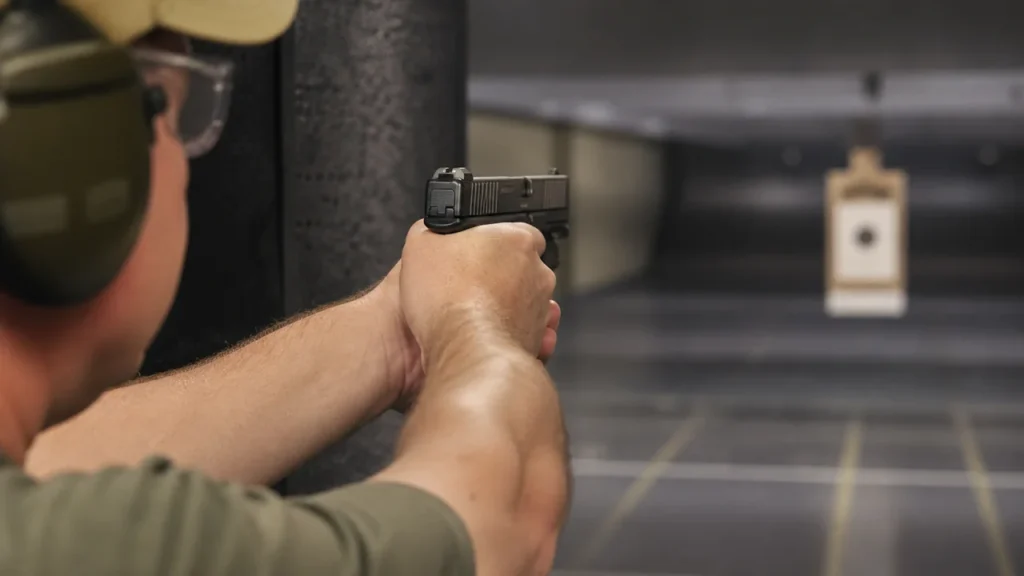
In modern practical shooting, the “Thumbs Forward” grip is common. The dominant hand holds the grip, while the supporting hand fits snugly against its free side. Both thumbs point forward, roughly parallel to the barrel. This grip helps hold the pistol more steadily and control its movement after the shot.
Two-handed shooting can be performed while standing, kneeling, or lying down.
Pistol stances: front stance, Weaver, and other variations
The front-grip or equilateral grip is a popular way to hold a pistol. Its main features are as follows:
The feet are shoulder-width apart, the feet are parallel, and the toes point toward the target.
The torso should be leaned forward slightly to compensate for recoil.
The arms are extended and positioned to form an isosceles triangle with the shoulders.
It should be noted that the front-stance provides good vertical stability, helps transfer recoil to the sides, and is suitable for shooting while wearing body armor.
One drawback of the balanced stance is that it offers less resistance to horizontal recoil compared to side stances.
The second popular option is the Weaver stance.
The key points to know for assuming the correct Weaver stance when shooting a pistol:
A side stance, with the strong foot positioned back and the weak foot stepped forward and slightly bent at the knee.
The torso is turned slightly at an angle.
The dominant hand is positioned straight and practically pushes the firearm forward. At the same time, the non-dominant hand, conversely, pulls it back, thereby creating a slight isometric tension.
The Weaver stance effectively absorbs recoil when using high-caliber firearms. However, coordination in this body position is more difficult, peripheral vision is limited, and shifting fire to other angles is somewhat slowed down.
Other popular pistol shooting stances include:
The Chapman stance, which is a variation of the Weaver stance. The leading arm is fully extended, while the supporting arm is slightly bent, which reduces neck strain and makes aiming easier.
The Center Axis Relock (CAR) tactical stance, in which the firearm is held closer to the body, the torso is turned outward, and the elbows are lowered. This is a specialized stance for confined spaces, such as a car interior, rather than a universal stance for traditional shooting range practice.
Aiming, Trigger Pull, and Recoil Control
After assuming the correct stance and selecting a grip, the shooter focuses on aiming and firing the shot.
While aiming, the shooter should keep their focus on the pistol’s front sight, while the rear sight and the target itself may be slightly blurred. The top edge of the front sight aligns with the horizontal line of the rear sight, and the gaps on either side should be equal. When aligning the sights with the target, the head and arms remain still. Adhering to the rules of aiming is crucial for achieving shooting accuracy.
When firing, the trigger is pulled with the pad of the index finger, positioned exactly in the center. The trigger is pulled with a smooth motion, without shifting the barrel. You should hone this skill to the point where the shot occurs as the logical conclusion of a smooth, controlled pull.
To control recoil, we recommend gripping the pistol firmly with your hands, but without clenching your shoulders and hands too tightly. The force of recoil will cause your hands to rise slightly—let it do so, and then smoothly return the barrel to the point of aim.
Common mistakes that throw off your shot
The main mistakes in stance when shooting a pistol include:
Incorrect pistol grip—holding it too low, with a weak grip, or crossing the thumbs behind the grip. This leads to palm injuries, increased recoil, and aim deviation.
Tense and raised shoulders, which cause stiffness and rapid fatigue, and thus make it difficult to hold the sights steady.
Semi-bent and lowered elbows negatively affect recoil control, as the barrel kicks up sharply after the shot.
Improper body balance, where body weight shifts to the heels or toes, leading to reduced stability and body sway while aiming.
Excessive forward or backward leaning of the torso—the main cause of disruption to the natural center of gravity, back strain, and the gun being pulled off the line of fire.
Knees that are too bent or too straight will not absorb the micro-vibrations during the shot and will amplify recoil.
How to train your stance and grip at the shooting range with an instructor
Training at a shooting range is the easiest and safest way to improve your shooting skills. You can check shooting range prices in Kyiv in advance to choose the right training format and plan your training budget.
There are several reasons to train at a shooting range:
Safety. First and foremost, shooters learn safety procedures and how to minimize the risks associated with using firearms under the guidance of experienced instructors.
Access to tested firearms and specialized equipment. Shooting ranges are equipped with everything necessary for safe and comfortable training, including high-quality training firearms, various types of targets, and the ability to practice at different distances.
Facility conditions. Proper lighting and clearly marked distances at the firing line minimize technical errors.
Quality of instruction. At a good shooting range, every instructor is an experienced professional with highly refined marksmanship skills. Beginner shooters receive information on safety rules for handling firearms, learn the basics of shooting, and gradually improve their accuracy.
Frequently Asked Questions
How do you hold a pistol correctly with both hands?
The correct two-handed grip on a pistol involves the dominant hand reaching deep into the grip, while the other hand supports the shooting hand, fills the remaining space snugly, and controls recoil. The thumbs should be pointing forward, parallel to the barrel, and without applying pressure.
What shooting stance is best for a beginner when shooting a pistol?
For a beginner, the front-facing or symmetrical stance is best when shooting a pistol, as it is the easiest to learn, most natural, and most stable. An alternative is the Weaver stance, where the shooter stands in a half-turn position, but it takes longer to master.
Why does the pistol move to the side after firing?
The pistol moves to the side or flips upward after firing because the barrel’s axis and the hand’s point of support do not align, which creates a rotational force.
How can you tell if your grip on the pistol is incorrect?
An experienced instructor can usually identify an incorrect grip on the pistol based on several signs. In this case, the points of impact on the target will show a characteristic deviation. In addition, instructors determine this by the weapon’s behavior during recoil and by the shooter’s physical sensations.
More on this topic
17.03.2026
Rules and conditions for storing weapons at home
Having an interesting hobby is one of the effective ways to relax, take a break from everyday work and get a boost of positive emotions. Some people like to ride a bicycle or bike, others like to play chess, and still others prefer hunting or shooting at a shooting range.
If you are planning to buy
30.04.2026
Top 10 Legal Weapons for Self-Defense
When it comes to self-defense, it's important to understand that it's not about aggression, but about your own safety. In today's world, where unpredictable situations can arise anywhere, many are forced to consider available ways to protect themselves and their loved ones. It's important to remembe
24.08.2026
Air Pistol for Self-Defense: Can It Be Used?
An air gun can cause pain and damage soft tissue, but it should not be considered a reliable or effective means of self-defense. The design parameters and characteristics of air guns—such as low stopping power, structural fragility, and dependence on gas pressure—as well as strict legal restrictions
17.03.2026
Rules and conditions for storing weapons at home
Having an interesting hobby is one of the effective ways to relax, take a break from everyday work and get a boost of positive emotions. Some people like to ride a bicycle or bike, others like to play chess, and still others prefer hunting or shooting at a shooting range.
If you are planning to buy
30.04.2026
Top 10 Legal Weapons for Self-Defense
When it comes to self-defense, it's important to understand that it's not about aggression, but about your own safety. In today's world, where unpredictable situations can arise anywhere, many are forced to consider available ways to protect themselves and their loved ones. It's important to remembe
24.08.2026
Air Pistol for Self-Defense: Can It Be Used?
An air gun can cause pain and damage soft tissue, but it should not be considered a reliable or effective means of self-defense. The design parameters and characteristics of air guns—such as low stopping power, structural fragility, and dependence on gas pressure—as well as strict legal restrictions
Darwin Shooting Club— we do not sell firearms
Our club does not sell or resell firearms. We exist to teach safe, conscious, and responsible handling of firearms.We conduct training sessions, safety briefings, and promote a culture of informed firearm ownership.