An air gun can cause pain and damage soft tissue, but it should not be considered a reliable or effective means of self-defense. The design parameters and characteristics of air guns—such as low stopping power, structural fragility, and dependence on gas pressure—as well as strict legal restrictions make them a risky choice for defending against a real threat. In a critical situation, such a weapon will not stop an attacker but may result in legal consequences for its owner. Air guns are intended for recreational and sporting shooting, for example, as part of тира Darwin Club.
In this article, we take an in-depth look at whether an air gun can be used for self-defense and what factors determine its effectiveness.
Can an air gun be used for self-defense?
The popularity of air guns often leads to confusion regarding their suitability for self-defense. The external characteristics of the weapon generally speak in favor of this choice: it is sold in specialty stores and does not require a license or permit to purchase, and its price is affordable for a wide range of buyers. In addition, many modern models are similar in design to well-known combat counterparts, such as the classic Makarov pistol or the famous Beretta 92 FS. The muzzle energy of some air gun models is more than enough to successfully shatter a glass bottle at close range. All these features create the illusion that an air pistol could be a convincing deterrent in a critical situation.
But the actual purpose of air guns is fundamentally different from self-defense. Air guns are designed exclusively for sports and recreational shooting, as well as for honing Rules for handling firearms during training at shooting ranges.
Relying on an air gun as a means of self-defense means exposing yourself to a double risk: remaining defenseless in the face of real aggression and, at the same time, facing criminal liability.
How effective is an air gun in a real dangerous situation?
An air pistol is ineffective as a means of self-defense. In some cases, it can even lead to an escalation of the conflict. It all comes down to the device’s characteristics — its power, stopping power, and the psychological factor, such as the risk of escalation.
Power and the ability to stop an attack
Before buying an air gun for self-defense, we recommend familiarizing yourself with its technical specifications. An air gun will not protect you from a real danger, since it has:
Low muzzle energy: the projectiles weigh very little (about 0.3 grams) and travel at low velocity. The muzzle energy of most air guns is less than 3 joules. An air gun pellet can cause pain, but it will not physically stop an attacker. And in winter, when wearing warm clothing, the impact is practically completely absorbed.
Dependence on gas: if the gun has been stored for a long time, for example, in a bag or pocket, the pressure in the CO₂ cylinder gradually decreases. This means the shot will be weak or may not fire at all.
Risk of Escalation and a False Sense of Security
Possessing an air gun often gives its owner a sense of overconfidence, creating a false sense of security. In crisis situations, this attitude leads to a loss of vigilance. In other words, instead of trying to avoid conflict or simply running away, the person engages in a verbal altercation, thereby escalating the conflict.
Furthermore, an air gun is not designed to incapacitate a person, especially when the person is under the influence of adrenaline or alcohol. A hit to more vulnerable areas is more likely to enrage an aggressive individual than to stop them. In addition, many air pistols look very similar to real firearms (such as the PM or TT, or a Glock), and in low light or under stress, an attacker might assume you’re holding a firearm and take drastic countermeasures — drawing a knife or a service pistol to defend their life.
We must not forget the legal consequences either. For example, if you point an air gun at law enforcement officers, they have the right to return fire with the intent to kill. And if a shot hits a vulnerable area (such as the eyes or face) and causes bodily injury, it is very difficult to prove in court that the self-defense was proportionate to the threat.
What Determines the Effectiveness of an Air Pistol
Effectiveness and Purpose Air guns are defined by a set of parameters, such as muzzle energy, caliber, and bullet type.
Muzzle energy, caliber, and projectile type
Muzzle energy is measured in joules (J). This characteristic indicates the bullet’s initial velocity:
Up to 3 J — the least powerful firearms, suitable for recreational shooting, shooting at paper targets, or at cans located at a distance of up to 10–15 meters.
3–7.5 J — air guns for sports and recreational shooting. Accuracy is guaranteed when firing at distances up to 25 meters.
Over 7.5 J — features fairly high penetrating power and can be used for hunting small game.
The caliber of the ammunition affects the bullet’s flight path, its resistance to wind, and the energy transferred to the target. The following calibers are typical for airguns:
4.5 mm – the most popular, with a straight trajectory and high velocity. Suitable for sports and recreational shooting.
5.5 mm — thanks to its greater mass, it retains the pellet’s energy over a longer distance. Used for hunting.
6.5 mm and larger — high stopping power; most often used in rifles for hunting medium-sized game.
The type of projectile used in air pistols affects their aerodynamics and behavior upon impact:
Steel pellets – ammunition for smoothbore firearms, which have poor aerodynamics but high penetration capability. They typically ricochet off hard surfaces.
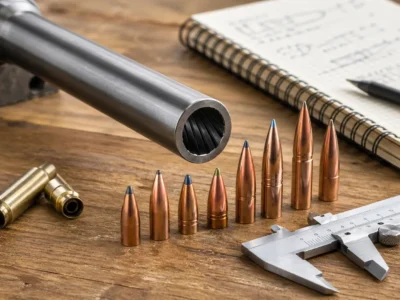
Lead bullets are used in rifled barrels and offer greater accuracy and group consistency. Thanks to their “shuttlecock” shape, they are quite stable in flight.
Lead bullets come with flat, hemispherical, conical, and expanding tips. The flat tip creates clean holes when fired and is suitable for practicing on paper targets. The hemispherical tip provides improved aerodynamics and preserves energy over long distances. The conical shape of the bullet’s head ensures greater penetration, while the expanding tip opens up upon impact, thereby causing greater damage during hunting.
Design, Energy Source, and Readiness for Use
The effectiveness of an airgun is determined by its design, muzzle energy source, and readiness for use.
In terms of design, the type and length of the barrel are important. A rifled barrel increases accuracy by spinning the bullet. Smoothbore airguns use pellets, which do not provide the same level of accuracy. The longer the barrel, the higher the bullet’s muzzle velocity. Additionally, it is important to consider the presence of gaps between parts (the quality of their assembly)—the smaller the gaps, the less gas escapes and the greater the shot’s power.
The use of carbon dioxide as an energy source depends on the air temperature—in cold weather, the pressure drops, reducing the shot’s power.
Using an air gun with a spring-piston system ensures consistent performance in any weather, but you must remember to cock the gun before each shot.
Readiness for use also affects the effectiveness of air pistols. For example, peak performance is achieved when the cylinder or reservoir is fully charged. As the gas is depleted, the muzzle velocity of the projectiles decreases. Regular maintenance and lubrication of the weapon, as well as the proper selection of ammunition, are equally important.
Which air pistol is best for self-defense
There is no single, best air pistol for real-world self-defense due to the design features and characteristics of air guns — specifically, their stopping power and energy source.
Certain models of air pistols are ideal for recreational and training shooting — that is, for practicing gun handling skills.
Among the tried-and-true airgun models for training and recreation, the following are worth noting:
MP-654K (based on the PM) – made of gun-grade steel, they closely replicate the original and allow you to practice assembling and disassembling a firearm.
Gletcher PM / CLT 1911 — similar to well-known pistols, great for recreational shooting.
Crosman 1377 — a well-known multi-compression pistol, suitable for practicing precision shooting at distances of 10 meters.
Legal Consequences of Using Air Guns in Ukraine
Let’s note right away that the rules for purchasing and the legality of owning air guns, as well as the lawfulness and legal assessment of their use in self-defense, are separate issues and are governed by entirely different legal provisions in Ukraine. Even if an air gun is purchased legally in a store, its use against a person will be assessed exclusively in accordance with the provisions of the Criminal Code of Ukraine and the regulations of the Ministry of Internal Affairs.
Air guns with a caliber of up to 4.5 mm may be freely purchased by individuals who are at least 18 years old. If the caliber exceeds 4.5 mm and the bullet velocity exceeds 100 m/s, a permit from the National Police and registration are required.
Important! Firing air guns outside of shooting ranges and shooting ranges — that is, in places not designated for this purpose—is strictly prohibited. Under Article 174 of the Code of Administrative Offenses, violators will be fined, and the weapons will be confiscated.
Regarding the legal assessment of necessary self-defense, Article 36 of the Criminal Code of Ukraine applies in this case. According to the law, self-defense and the protection of life using air guns are not prohibited. If the case goes to court, the court will assess whether the use of force was proportionate or exceeded the limits. Simply put, the court will examine in detail the danger posed by the attack and the harm inflicted on the attacker. For example, if multiple shots are fired and hit vulnerable parts of the body, the assailant may accidentally sustain serious injuries. And if the assailant was unarmed, the person who acted in self-defense may face criminal charges under Article 124 of the Criminal Code of Ukraine for exceeding the limits of self-defense.
At the same time, Part 5 of Article 36 of the Criminal Code of Ukraine states that the use of any weapon, including an air gun, does not constitute an excess of self-defense if the attacker was armed (including a knife) and if the attack is carried out by a group of persons (two or more people), as well as in cases where there was an intrusion onto private property.
Let’s briefly compare the legal consequences of using air guns:
Criterion
Acquisition and Possession
Use in Self-Defense
Regulatory Framework
Ministry of Internal Affairs Order No. 622, Code of Administrative Offenses
Article 36 of the Criminal Code of Ukraine
Key Parameter
Technical Specifications (4.5 mm / 100 m/s)
Reality of the Threat and Proportionality of Harm
What the Law Checks
Presence of documents, age, location of shooting
Presence of an armed/group attack
Consequences of a violation
Fine, confiscation of the weapon (administrative liability)
Criminal liability for causing injury
What to Consider Instead of Air Guns for Personal Safety
As an alternative to pepper spray for personal safety, you can consider various devices; however, before choosing the option that’s right for you, we recommend that you thoroughly review the legal regulations governing the purchase, carrying, and use of each device.
Legal alternatives for self-defense include:
Pepper spray canisters for civilian use — an effective, affordable, and simple option based on a mixture of pepper extracts or tear gas. Spray canisters are highly accurate and can be used both indoors and outdoors (including in windy weather). Aerosol devices create a wide cloud, making it easier to hit the target. Pepper spray canisters are available for purchase by individuals 18 years of age or older. Please note that civilians are prohibited from purchasing canisters marked with an “M,” which are special-purpose devices intended for law enforcement.
Stun guns—as a rule, they require direct contact, but are truly effective when used at point-blank range. The market offers both contact models and projectile (cartridge) models, which allow you to incapacitate an attacker from a distance of up to 3–5 meters. They are an excellent deterrent against stray dogs, as the loud crackling sound scares the animals away. Important note: Civilians aged 18 and older may only purchase certified models that use a low-voltage current that does not cause serious bodily injury.
Aerosol devices are a hybrid model combining a pistol and a gas canister. They fire liquid pepper from special canisters. Such a device can reach longer distances and is not affected by wind, and it resembles a pistol in appearance.
Sound and light-and-sound devices, such as a pocket siren or anti-dog device, are designed to attract attention with a bright light, a loud bang, or a shrill sound. They draw the attention of passersby and can temporarily disorient an attacker.
Should You Buy an Air Pistol Specifically for Self-Defense?
Let’s summarize: Is it really worth buying an air gun for self-defense? No, air pistols are not suitable for this purpose. This is a dangerous misconception that can have serious consequences, since, on the one hand, an air gun is incapable of stopping an aggressive person, and on the other hand, it creates a false sense of security, may provoke the attacker into committing a real crime against you, or lead to legal problems for exceeding the bounds of self-defense.
Frequently Asked Questions
Is it legal to carry an air gun for self-defense?
Yes, you can carry an air gun for self-defense, but keep in mind that this type of weapon is not very effective, and using it outside of designated facilities and areas can result in legal consequences. Air guns are intended exclusively for sports and recreational use.
Which is better for self-defense: a non-lethal firearm or an air gun?
For protection against a real threat, a non-lethal firearm is much more effective than an air gun, as it is specifically designed for this purpose and has a much greater stopping power. Air pistols are sports and training models.
Is it legal to use an air gun for self-defense?
Using an air gun for self-defense against a person is extremely risky from a legal standpoint and, as a rule, illegal. Yes, by law, an air gun is not considered a means of self-defense; however, its use may be viewed as exceeding the limits of necessary self-defense.
How many meters can an air gun shoot?
The effective range for accurate shooting with most modern air guns is approximately 10–15 meters. The pellet can retain its kinetic energy even at greater distances, but accuracy and effectiveness drop sharply beyond this range.
What is the point of an air pistol?
An air pistol is an excellent option for safe and inexpensive training and sport shooting, for developing and honing accuracy skills, as well as for learning proper gun handling.
More on this topic
30.04.2026
Rifle barrel twist: what it is and how to choose the right bullet weight for your rifling pitch
Shooters often face a frustrating situation. They've purchased an expensive rifle and high-quality optics. They've selected ammunition from a well-known brand. But instead of a neat group, the target displays a chaotic scattering of holes. At this point, many begin to look for a problem with the sco
15.03.2026
Top 10 Legal Weapons for Self-Defense
Shooting at a shooting range has long ceased to be just a pastime. Today, it's a fully-fledged way to develop concentration, discipline, and accuracy. While the choice was previously severely limited to certain gun models, more and more shooting clubs are now using popular carbine brands. These type
02.07.2026
Gun Muzzle Brakes: Types, Purpose, and How They Work
When a firearm is discharged, a powerful stream of superheated propellant gases is generated; as these gases exit the barrel, they create a bright flash, thereby revealing the shooter’s location. To address this issue, special devices are used, the most common of which is the flash suppressor.
30.04.2026
Rifle barrel twist: what it is and how to choose the right bullet weight for your rifling pitch
Shooters often face a frustrating situation. They've purchased an expensive rifle and high-quality optics. They've selected ammunition from a well-known brand. But instead of a neat group, the target displays a chaotic scattering of holes. At this point, many begin to look for a problem with the sco
15.03.2026
Top 10 Legal Weapons for Self-Defense
Shooting at a shooting range has long ceased to be just a pastime. Today, it's a fully-fledged way to develop concentration, discipline, and accuracy. While the choice was previously severely limited to certain gun models, more and more shooting clubs are now using popular carbine brands. These type
02.07.2026
Gun Muzzle Brakes: Types, Purpose, and How They Work
When a firearm is discharged, a powerful stream of superheated propellant gases is generated; as these gases exit the barrel, they create a bright flash, thereby revealing the shooter’s location. To address this issue, special devices are used, the most common of which is the flash suppressor.
Darwin Shooting Club— we do not sell firearms
Our club does not sell or resell firearms. We exist to teach safe, conscious, and responsible handling of firearms.We conduct training sessions, safety briefings, and promote a culture of informed firearm ownership.