Gun Muzzle Brakes: Types, Purpose, and How They Work
02.07.2026Author: Charles Darwin
When a firearm is discharged, a powerful stream of superheated propellant gases is generated; as these gases exit the barrel, they create a bright flash, thereby revealing the shooter’s location. To address this issue, special devices are used, the most common of which is the flash suppressor.
Modern muzzle brakes have a fairly simple design and differ in their purpose and effectiveness. Some models are used at night, while others help reduce muzzle rise during firing or are combined with other types of muzzle devices.
In this article, we’ll explore why a flash hider is needed for firearms, what types are available on the market today, and how to choose the right device.
What Is a Flash Hider and Why Is It Needed?
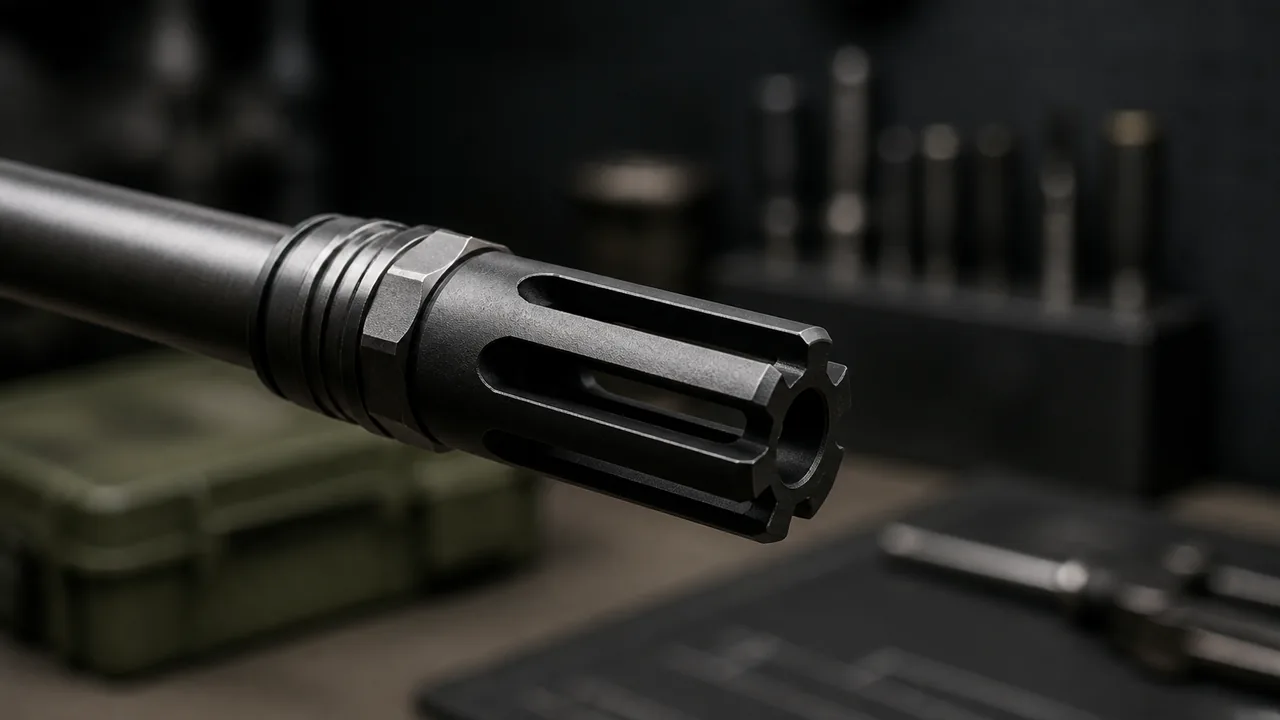
A flash hider (also known as a flash suppressor) is a small device or attachment fitted to the muzzle of a firearm. It performs several important functions, including improving shooting comfort and accuracy.
The main purpose of a flash hider is to reduce the visible flash during firing. Gunpowder particles burn not only inside the barrel but also outside it, and the resulting gas flow is characterized by high temperature and brightness. Thanks to the muzzle brake’s special design, which includes chambers, holes, and slots, the gases are redirected, cooled, and dispersed, thereby reducing the concentration of particles moving in a single direction. As a result, the flash after a shot is significantly reduced and becomes virtually imperceptible.
Furthermore, in real combat situations, a flash suppressor helps with concealment. Even brief flashes can lead to the shooter being detected by night vision devices and thermal imagers, so using flash suppressors significantly reduces the risk of giving away one’s position. A flash suppressor is an essential device for any tactical operation.
In addition to their primary function—suppressing the muzzle flash—flash suppressors provide a number of other benefits, such as:
Partial reduction of recoil by redirecting the gas flow to the sides or upward, which compensates for barrel lift during firing.
Acts as a stabilizer during automatic fire. Thanks to its carefully designed slots and internal geometry, the device dampens barrel vibrations and improves accuracy during a burst of fire.
Protects the shooter’s eyesight. In the dark, a bright flash is produced during firing, which temporarily blinds the shooter. As a result, this directly affects the effectiveness of subsequent shots. The flash suppressor dampens the flash, which helps preserve vision, maintain orientation, improve visibility, and speed up sight adjustment, thereby making shooting more effective.
How a Gun Muzzle Brake Works
The main mechanisms of a gun muzzle brake:
Cooling and dispersion. A device, such as a slotted muzzle brake, divides the overall flow of hot powder gases into many small streams. This significantly increases the surface area where the gases come into contact with cool air, leading to a sharp drop in their temperature.
Powder afterburning. The presence of slits and diffusers allows oxygen from the surrounding environment to enter the gas jet, causing the powder residues to burn off quickly before they are expelled from the device.
Maintaining the line of sight. Because the gases are directed to the sides and upward, when shooting from a prone position, dust from the ground does not rise, and the optics remain protected from soot.
Protection of the eyes. The flash suppressor acts as a mechanical shield, shielding the shooter’s eyes from the flash.
Some devices combine the mechanisms listed above with a muzzle brake function, which uses gas pressure to reduce recoil and muzzle rise upon firing.
Types of flash suppressors
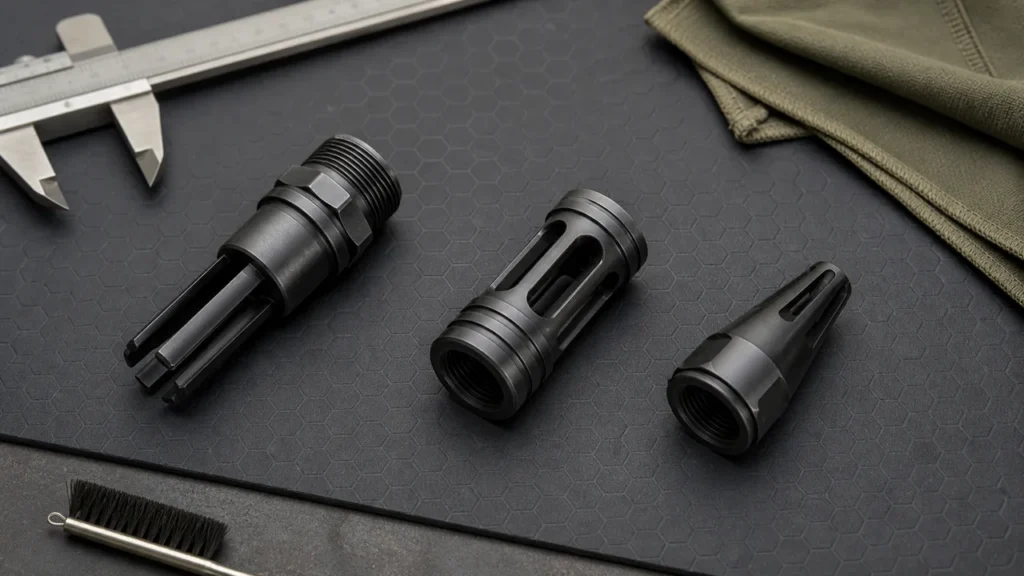
Modern flash suppressors for firearms are classified based on their design features and operating principles. There are open-slot, closed, conical, and combined models.
Open-slit muzzle brakes
Open-slit muzzle brakes are considered classic models. They feature narrow, longitudinal slits around the body that split, disperse, and direct the exhaust gases to the sides. Advantages: effective concealment, improved nighttime shooting performance, and minimal impact on the combat unit’s balance.
This model is widely used, especially in military firearms.
Closed-chamber muzzle brakes
Closed-chamber muzzle brakes feature internal compartments in which gases expand sequentially, then cool and disperse. This allows for a higher degree of flash suppression.
In addition to chamber-type flame arresters, there are so-called vortex flame arresters, which feature special internal spiral channels. The gases swirl within these channels, thereby reducing pressure and effectively extinguishing muzzle flashes.
Conical and Combined Models
Conical flash suppressors feature a flared bell (funnel). As the propellant gases expand within the bell, they cool rapidly and lose pressure.
Conical flash suppressors effectively suppress muzzle flash, have proven themselves in challenging conditions, and are often used in carbines and machine guns.
Combined devices, or DTK afterburners, consist of a housing with additional expansion chambers, sometimes incorporating a muzzle brake function. They operate by burning residual gunpowder in the chamber to reduce muzzle flash, while simultaneously redirecting gases to minimize recoil and muzzle rise. Their main advantage is versatility, as they not only conceal the flame but also improve accuracy and shooting comfort.
How does a flash suppressor differ from a muzzle compensator and a silencer
Muzzle compensator (muzzle brake-compensator), silencer and a firearm flash suppressor have different designs and purposes.
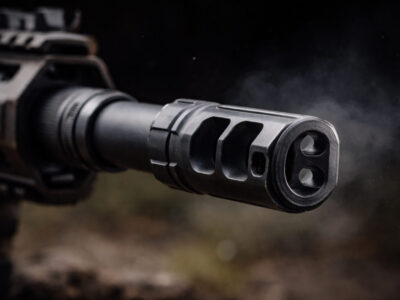
Unlike a flash suppressor, which reduces or completely hides the bright flash during firing by dispersing or diverting and cooling the propellant gases, a muzzle brake-compensator improves shooting accuracy by reducing recoil impulse and preventing the firearm from being thrown to the side or the barrel from being thrown upward. The muzzle brake-compensator works by directing the escaping propellant gases through special openings and chambers in the direction opposite to the recoil. Its main advantage is the shooter’s ability to quickly regain sight alignment between shots and maintain control of the weapon.
A silencer is a device designed for silent firing, as it significantly reduces the sound level of a shot or alters its acoustic frequency so that the source is difficult to identify. The design features a large cylindrical body with multiple internal chambers that delay, expand, and trap the propellant gases, as well as completely extinguish the muzzle flash.
In practice, confusion arises due to the presence of so-called hybrid models on the market. For example, closed-type DTKs are very similar to silencers, but are structurally designed to reduce recoil and extinguish the flash. Combined flash suppressor models, in addition to their primary purpose, reduce recoil and muzzle rise, just like a muzzle brake-compensator.
Flash suppressors for rifled and smoothbore firearms
Flash suppressors for rifled firearms are primarily used to disperse and cool propellant gases. Therefore, they have a greater number of teeth, slits, or petals.
Muzzle brakes for smoothbore shotguns must handle a large volume of gases without obstructing the passage of shot. Their design must be more spacious, with a larger diameter and less coarse internal elements.
The main difference between muzzle brakes for rifled and smoothbore firearms lies in the ammunition and the characteristics of the shot:
Characteristics
Rifled firearms
Smoothbore firearms
Ammunition type
Small-caliber bullet
Shot, buckshot, or bullet
Gas Pressure
Typically higher
Projectile velocity
Higher
Lower
Barrel bore diameter
Relatively small
Significantly larger
Gas volume
Smaller
Greater
Features of muzzle brakes for rifled firearms
A muzzle brake for rifled firearms has a number of features:
A well-defined and thoughtfully designed system of slots, chambers, and openings. As noted above, muzzle devices come in open (with three, four, or five prongs), closed (“Birdcage” type), and combined (with a compensating effect) types. Their main purpose is to distribute the gas flow into several jets and accelerate cooling.
High muzzle flash suppression efficiency. Rifle cartridges are characterized by the release of large amounts of superheated powder gases and, to some extent, unburned powder; therefore, a high-quality flash suppressor can quickly and discreetly reduce the muzzle flash upon firing.
Relatively small internal diameter. Typically, the device’s internal diameter is slightly larger than the bullet’s caliber; for example, for 5.56 mm, the bore is about 6–7 mm, and for 7.62 mm, it is about 8–9 mm. This design allows for better control of the gas flow.
They can serve as the basis for other devices. For example, modern flash suppressors for rifled firearms also function as adapters for sound suppressors, as well as components of combined, quick-detachable muzzle attachments and mounts.
Flash suppressor for smoothbore firearms
A flash suppressor for smoothbore firearms, in turn, has several design features:
An enlarged internal diameter compared to devices for rifled barrels. This is necessary to ensure the safe passage of shot, buckshot, slugs, or bullets.
Simplified design. These include cylindrical attachments, tubular designs, and expansion chambers. Complex serrated designs are less common.
Designed for a large volume of powder gases. When fired, 12-gauge ammunition expels a significant volume of gases through a wide barrel bore. Therefore, the muzzle device does not so much completely suppress the flash as it disperses it and directs it away from the shooter’s line of sight.
Design Principles. Muzzle brakes for smoothbore firearms generally do not have inward-projecting elements, as these could strike the cartridge case, deform the shot, negatively affect shooting accuracy, and also increase the risk of damage to the device. Therefore, the interior of such muzzle brakes is always less “aggressive” than that of rifle models.
How to Choose a Muzzle Brake for Your Gun
Which firearm muzzle brake to choose depends directly on the type of firearm, its caliber, and its intended use.
Caliber, Threads, and Barrel Compatibility
First and foremost, you should ensure that the flash suppressor fully matches the specifications of your firearm, specifically its caliber. Mismatched muzzle device specifications can lead to reduced effectiveness and even damage to the barrel. In particular, the thread diameter is important.
Different models are designed for specific sizes and calibers, so choose only those flash suppressors that are fully compatible with your firearm.
Size, Weight, and Material
Modern flame arresters are manufactured from materials that vary in characteristics and weight:
Steel—one of the most common, classic, and durable materials—guarantees longevity even under intense stress. However, it should be noted that it adds weight to the front of the barrel, thereby shifting the weapon’s balance forward.
Titanium—a lighter and more corrosion-resistant material. It reduces the overall weight of the firearm (it is approximately one and a half times lighter than steel models), but is significantly more expensive. A good option for hunters and shooters who need to reduce the overall strain on their legs.
It’s worth mentioning muzzle devices with a ceramic coating—modern flash suppressors that offer improved thermal insulation and concealment in the infrared spectrum.
It’s important to know that heavier models better dampen recoil, while lighter ones significantly increase mobility and do not disrupt the weapon’s balance when shooting from the hip. Therefore, the weight of the muzzle brake is chosen based on the type of activity: for dynamic hunting and off-the-cuff shooting—no more than 250–300 grams; for precision shooting—heavier, hybrid models that help maintain the line of sight and minimize barrel rise; for night shooting—models with an extended chamber.
You should also consider the fact that so-called “fork-type” and lightweight, open models can produce an audible ringing sound during firing, which may give away the shooter’s position.
Conditions and Purposes of Use
Depending on the conditions and intended use, consider the following when selecting a flash suppressor for your firearm:
Time of day. For nighttime operations, models that minimize the muzzle flash as much as possible (such as closed combination and conical types) are suitable.
Location. When shooting from cover or indoors, the best option is the so-called “funnel” type, which redirects gases forward.
Firing Dynamics. Combined muzzle brakes help quickly return the gun to the line of sight after firing and maintain orientation.
In summary, flash suppressors are practical and popular muzzle attachments. They help reduce the brightness of the muzzle flash, improve control over the weapon, protect the shooter’s eyes, and maintain the shooter’s concealment. With their simple design and high reliability, modern models are used not only for tactical and combat missions but also in peacetime—for training at shooting clubs, at shooting ranges, and in competitions.
More on this topic
11.03.2026
What is a muzzle brake compensator
For comfortable shooting, there are special devices that reduce the noise of the shot, muzzle flash, barrel rise, and recoil. We are talking about the muzzle brake compensator, or MBC. It is easily attached to the muzzle of the barrel and simply removed, without the need for additional equipment.
F
17.03.2026
Basic safety precautions when using firearms
Firearms are not toys. Even experienced shooters regularly remind themselves of simple but vital rules. Safety always comes first — both at the shooting range and when storing, transporting, and maintaining firearms. In this article, we will discuss the key safety precautions during shooting that ev
30.04.2026
What are MOA and MRAD: how to calculate sight adjustments
At distances beyond 100 meters, the bullet begins to noticeably lose altitude. Gravity pulls it toward the ground. Wind moves it to the side. If you aim precisely at the center of the target without taking these factors into account, you'll miss. Successful long-range shooting requires an understand
11.03.2026
What is a muzzle brake compensator
For comfortable shooting, there are special devices that reduce the noise of the shot, muzzle flash, barrel rise, and recoil. We are talking about the muzzle brake compensator, or MBC. It is easily attached to the muzzle of the barrel and simply removed, without the need for additional equipment.
F
17.03.2026
Basic safety precautions when using firearms
Firearms are not toys. Even experienced shooters regularly remind themselves of simple but vital rules. Safety always comes first — both at the shooting range and when storing, transporting, and maintaining firearms. In this article, we will discuss the key safety precautions during shooting that ev
30.04.2026
What are MOA and MRAD: how to calculate sight adjustments
At distances beyond 100 meters, the bullet begins to noticeably lose altitude. Gravity pulls it toward the ground. Wind moves it to the side. If you aim precisely at the center of the target without taking these factors into account, you'll miss. Successful long-range shooting requires an understand
Darwin Shooting Club— we do not sell firearms
Our club does not sell or resell firearms. We exist to teach safe, conscious, and responsible handling of firearms.We conduct training sessions, safety briefings, and promote a culture of informed firearm ownership.