What are MOA and MRAD: how to calculate sight adjustments
30.04.2026Author: Charles Darwin
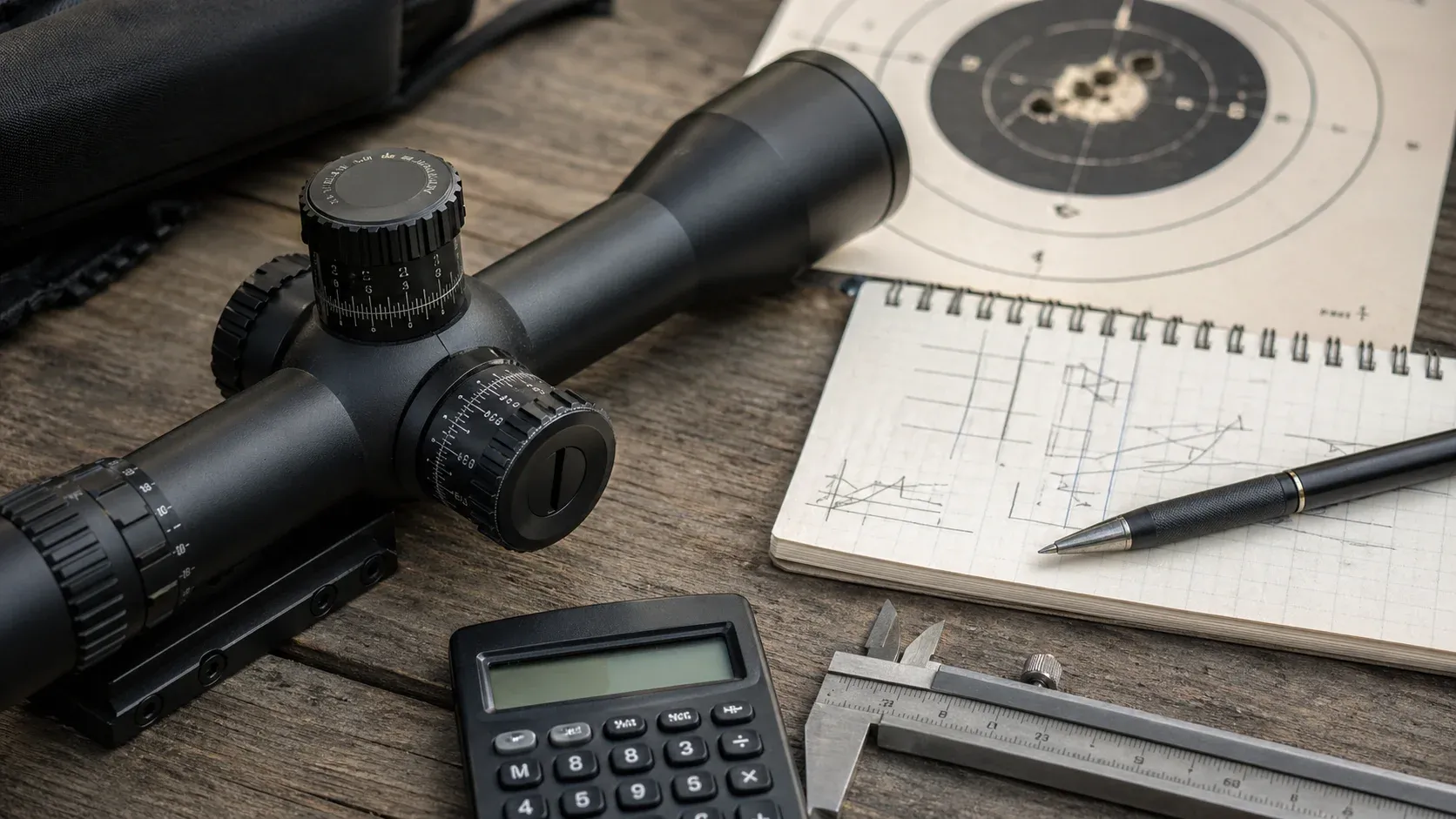
At distances beyond 100 meters, the bullet begins to noticeably lose altitude. Gravity pulls it toward the ground. Wind moves it to the side. If you aim precisely at the center of the target without taking these factors into account, you’ll miss. Successful long-range shooting requires an understanding of angular values. These units allow you to precisely adjust your scope to a specific distance. We’ll examine two main measurement systems. You’ll understand the logic behind your optics and be able to make the necessary adjustments to your settings. For those who want to consolidate this knowledge in practice, our club offers shooting courses where you can apply the theory in real-world conditions.
Basics: What is a Minute of Angle (MOA)?
Let’s start with the classical system. Any circle is divided into 360 degrees. One minute of angle is exactly one sixtieth of one degree. In English, this term is “Minute of Angle.” Shooters value this system for its accuracy. The MOA value increases with distance. This is because the angle widens with distance from the shooter.
The values of 1 MOA at 100 meters and beyond look like this:
At 100 meters, the deviation is 2.91 centimeters.
At 200 meters, this value increases to 5.82 centimeters.
At 300 meters, the bullet will deviate by 8.73 centimeters.
Many shooters use the concept of “Shooter’s MOA.” They round the value to the nearest inch per hundred yards. This is convenient for quick mental calculations. But at longer ranges, this error becomes noticeable. An error in calculations can lead to a miss. Understanding the moa unit is essential for every rifle owner. It’s the foundation for working with most hunting scopes.
Basics: What is a Milliradian (MRAD or MIL)?
The milliradian system is built on a different logic. It’s closely related to the metric system. A milliradian, or mil, is one thousandth of a radian. In practice, this yields a very simple rule. One milliradian at 100 meters is always equal to ten centimeters. You don’t need to mess around with inches or fractions.
Calculations in the MRAD system are intuitive:
100 meters = 10 centimeters.
200 meters = 20 centimeters.
500 meters = 50 centimeters.
Military experts prefer the milliradian unit. The system allows for quick mental calculations. You simply move the decimal point. This saves time when preparing to shoot. When the observer transmits data, shooters instantly understand the scale of the adjustment. The decimal system eliminates many mathematical errors.
Comparison of systems: MOA vs. MRAD
The choice of system often depends on personal preference and objectives. Hunters often choose MOA. Hunting shooting is typically conducted at short distances, and the inch system seems quite familiar here. Minute scopes often allow for very fine adjustments. Their adjustment increments are usually smaller.
Competitors and tactical shooters choose the milliradian system. It offers a speed advantage. You can count faster and spin the turrets faster. Let’s compare the main parameters in the table.
Characteristic
MOA System
MRAD System
Value at 100 meters
~3 centimeters
10 centimeters
Typical click (100 m)
~0.7 centimeters
1 Centimeter
Mathematics
Fractions and Inches
Decimals and Centimeters
Applications
Hunting, Classic
Sports, Tactics
One MIL holds approximately 3.44 minutes of arc. If you plan to work over longer distances, metric logic will be more convenient. It eliminates complex formulas. You’ll be able to focus on the shot itself.
Click Value on the Scope Turrets
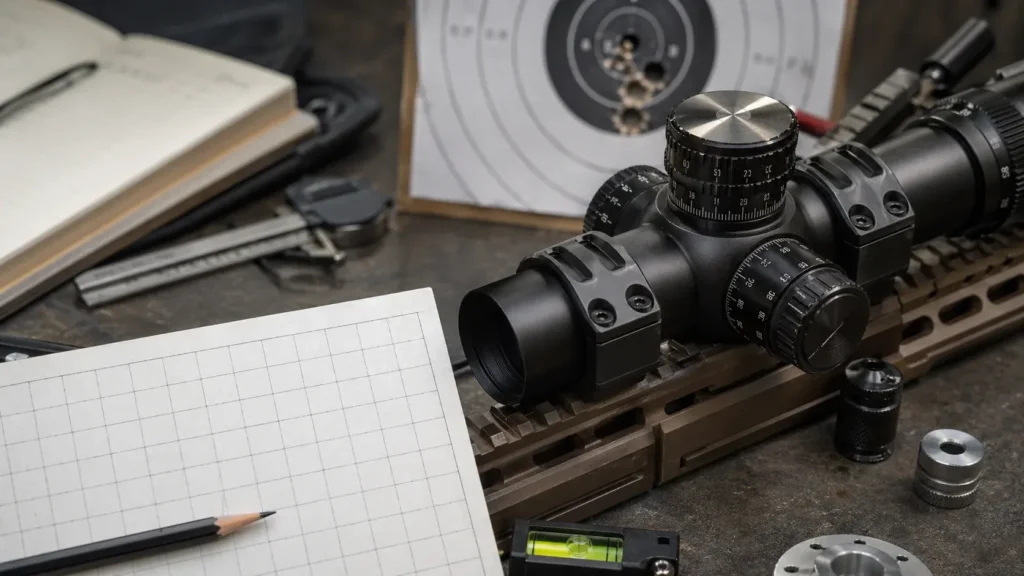
When you rotate the turrets, you hear clicks. Each click moves the reticle by a certain amount. The click value of any scope is indicated on the body. Typically, these values are 1/4 MOA or 0.1 MIL.
At 100 meters, one click works like this:
In a 1/4 MOA system, the bullet will move approximately 0.7 centimeters.
In a 0.1 MIL system, the bullet will move exactly 1 centimeter.
As the distance increases, the click value increases proportionally. At 300 meters, one click in mils will move three centimeters. If you need to raise the point of impact by fifteen centimeters, you make five clicks. For minute systems, calculations will be more complex. Always consider this when choosing a scope. Ease of adjustment affects the final shooting result.
Scope Reticle and Focal Planes
A modern Mil-Dot reticle allows you to make adjustments without rotating the turrets. You can aim at additional dots or marks. However, the accuracy of such adjustments depends on the scope’s design. Optics are divided into models with a first and second focal plane.
In scopes with a first focal plane (FFP), the reticle changes size as you change magnification. As you zoom in on the target, the reticle grows with it. This is convenient for practical shooting. All reticle divisions remain accurate at any magnification. You can use it for measurements at any time.
Scopes with a second focal plane (SFP) have a static reticle. It does not change appearance when zooming. The reticle divisions are accurate only at a specific magnification. This is usually the maximum magnification. If you change the magnification, all your reticle calculations will become incorrect. This often leads to annoying mistakes at the shooting range.
How to Determine the Range to a Target Using a Reticle
Many people want to know how to use a Mil-Dot reticle to estimate distances. This is a useful skill. You need to know the approximate size of the object in meters. For example, a chest target is half a meter high. You calculate the number of mils the target occupies in your reticle.
The calculation formula is as follows: You multiply the target size in meters by 1,000. You divide the resulting number by the number of mils in the reticle. The result is an accurate range in meters. If the target occupies one mil, then it is 500 meters away. This method requires practice. It helps in situations where a laser rangefinder is unavailable.
Practical Algorithm for Making Adjustments
Let’s look at the algorithm for preparing to fire.
Step 1. First, understand how to determine the range to the target. Use a rangefinder or your own reticle.
Step 2. Calculate the elevation correction. Find the bullet drop value for your range on the ballistics table.
Step 3. Consider the wind. Wind always blows the bullet. You need to estimate its strength and make the elevation correction.
Step 4. Make adjustments. You can spin the turrets or use dotted lines on the reticle.
Every step is important. A miscalculation of fifty meters can result in a miss. Careful preparation ensures accuracy. Gradually, these actions will become automatic.
Typical Calculation Mistakes
The most common mistake is mixing different systems. Don’t try to count in inches at metric distances. You’ll get confused by the numbers. If your scope uses mils, use only centimeters and meters. This will simplify your work and reduce the risk of error.
The second problem is the quality of the mechanics. In budget scopes, the click value may not match the actual value. You make ten clicks, and the bullet moves an unpredictable amount. The only way to verify this is by shooting. Draw a reticle with precise dimensions on paper. Check that the clicks correspond to the actual bullet movement.
SFP scope owners often forget to check the magnification. They adjust the reticle at low magnification. This always leads to a miss. Always check the position of the magnification ring. It’s best to train yourself to shoot at the magnification your mil-dot reticle is designed for.
Shooter’s Cheat Sheet
Remember a few simple rules for speed:
One mrad at 100 meters is ten centimeters.
One minute of angle is approximately three centimeters at 100 meters.
To determine the range: (Size in meters * 1000) / Mils = Distance.
One click in mils at 100 meters is one centimeter.
Choose one system and work exclusively within it.
Understanding angular values makes shooting predictable. You’ll begin to see not just a picture, but a clear coordinate system. At Darwin Club, we’ll help you master these skills in practice. Instructors will demonstrate all the nuances of working with drums and nets. Regular training will help you perfect your calculations. We look forward to seeing you at the shooting range to achieve new results.
More on this topic
26.12.2025
How to properly clean rifle rifle after shooting
Cleaning a gun is a fundamental procedure for maintaining its smooth operation and longevity. Regardless of its intended use—hunting, sport, or self-defense—proper cleaning helps prevent a variety of problems, including corrosion, jamming during shooting, and decreased accuracy.
In this article, we
17.03.2026
What is a cartridge caliber — table and applications
One of the key parameters when choosing a weapon is the cartridge caliber. This characteristic directly affects the ballistics of ammunition, shooting accuracy, recoil, and the scope of application of the combat unit.
In hunting, sport, and military practice, it is the choice of caliber that determ
17.03.2026
Rules and conditions for storing weapons at home
Having an interesting hobby is one of the effective ways to relax, take a break from everyday work and get a boost of positive emotions. Some people like to ride a bicycle or bike, others like to play chess, and still others prefer hunting or shooting at a shooting range.
If you are planning to buy
26.12.2025
How to properly clean rifle rifle after shooting
Cleaning a gun is a fundamental procedure for maintaining its smooth operation and longevity. Regardless of its intended use—hunting, sport, or self-defense—proper cleaning helps prevent a variety of problems, including corrosion, jamming during shooting, and decreased accuracy.
In this article, we
17.03.2026
What is a cartridge caliber — table and applications
One of the key parameters when choosing a weapon is the cartridge caliber. This characteristic directly affects the ballistics of ammunition, shooting accuracy, recoil, and the scope of application of the combat unit.
In hunting, sport, and military practice, it is the choice of caliber that determ
17.03.2026
Rules and conditions for storing weapons at home
Having an interesting hobby is one of the effective ways to relax, take a break from everyday work and get a boost of positive emotions. Some people like to ride a bicycle or bike, others like to play chess, and still others prefer hunting or shooting at a shooting range.
If you are planning to buy
Darwin Shooting Club— we do not sell firearms
Our club does not sell or resell firearms. We exist to teach safe, conscious, and responsible handling of firearms.We conduct training sessions, safety briefings, and promote a culture of informed firearm ownership.