Rifle barrel twist: what it is and how to choose the right bullet weight for your rifling pitch
30.04.2026Author: Charles Darwin
Shooters often face a frustrating situation. They’ve purchased an expensive rifle and high-quality optics. They’ve selected ammunition from a well-known brand. But instead of a neat group, the target displays a chaotic scattering of holes. At this point, many begin to look for a problem with the scope or the quality of the gunpowder. However, the root of the problem is often hidden deeper. It’s about the internal geometry of the gun. The key parameter here is the twist rate of the rifling. Understanding this characteristic helps transform shooting from guesswork into a conscious process.
How does a barrel twist rate work?
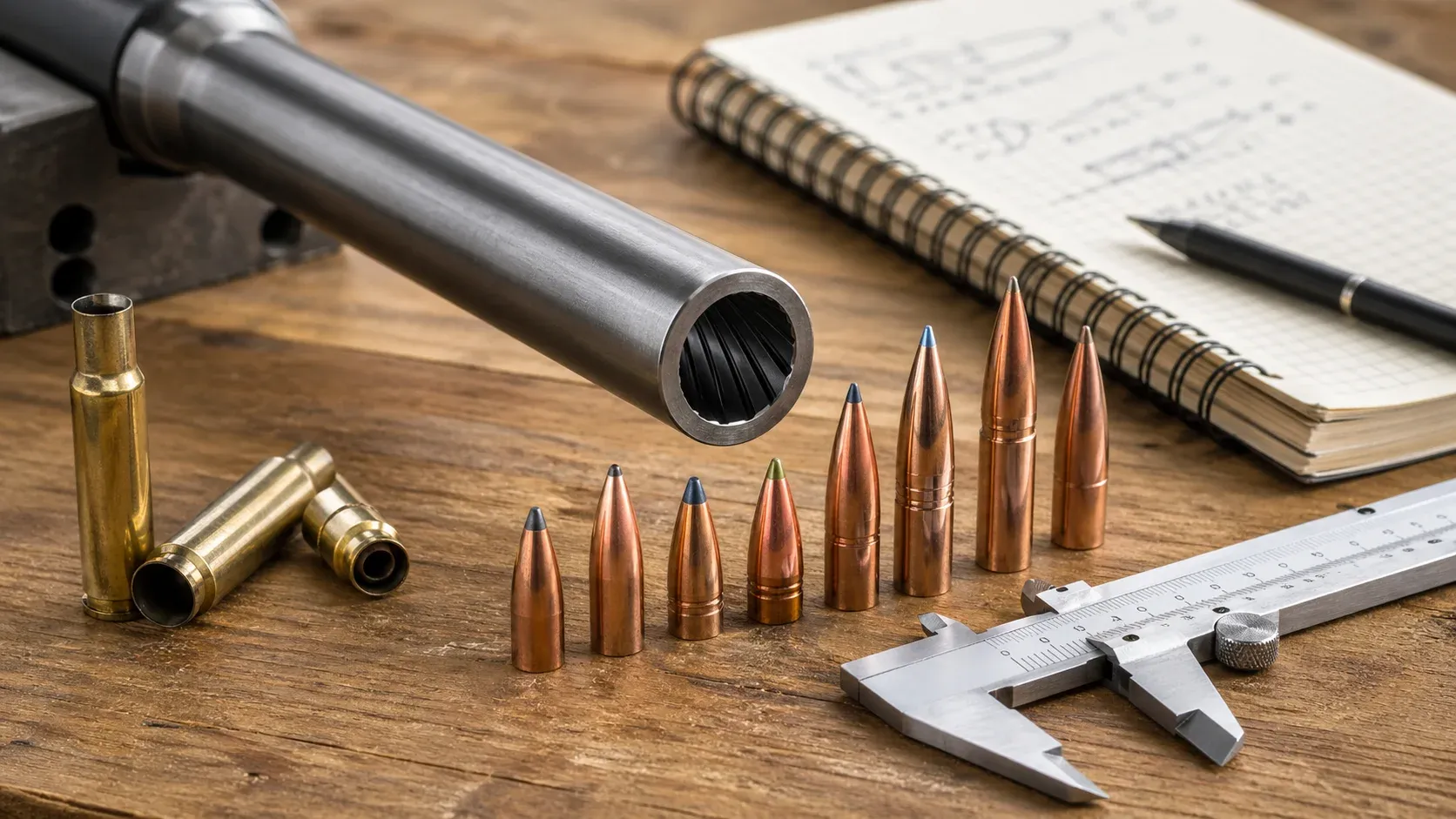
What is the purpose of rifling in a barrel? In a rifled gun, it acts as a guide. When fired, the bullet enters these spiral grooves. The bore causes the projectile to spin around its axis. This movement creates a gyroscopic effect. Think of a typical children’s top. While it spins quickly, it remains vertical. If the spin slows, the top begins to wobble and falls. The same thing happens to the bullet. The spin stabilizes it in flight.
Twist is the distance in inches it takes the bullet to complete one revolution. If the specification shows 1:10, it means the following: the projectile will rotate 360 degrees, traveling 10 inches inside the barrel. The lower the second number, the “faster” the rifling. A short twist rate spins the bullet more. A shallow twist rate, such as 1:12, produces a smoother spin.
The bullet’s spin rate upon exiting the barrel can reach 3,000 revolutions per second. This is an enormous amount. This is what allows the projectile to resist wind and maintain accuracy at range.
How to find your barrel’s twist rate
Most manufacturers mark the twist rate directly on the outer surface of the metal. Usually the numbers are stamped next to the caliber indication. You may see markings like 1:7″, 1-9, or Twist 10. If there are no markings, you can find the parameters yourself.
You will need a cleaning rod with ball bearings and a thick patch. The measurement process is as follows: Insert the cleaning rod into the barrel. Attach a flag made of electrical tape to the rod. Make a mark on the cleaning rod at the edge of the cut. Slowly push it forward. When the flag completes a full rotation, make a second mark. The distance between them is the desired rifling pitch. For accuracy, you can repeat the measurement several times.
Steel processing methods and the type of equipment at factories can cause slight deviations from the stated figures. Personal measurement will help you determine the actual characteristics of a specific rifle. This is important for those striving for maximum accuracy.
Why twist affects bullet selection
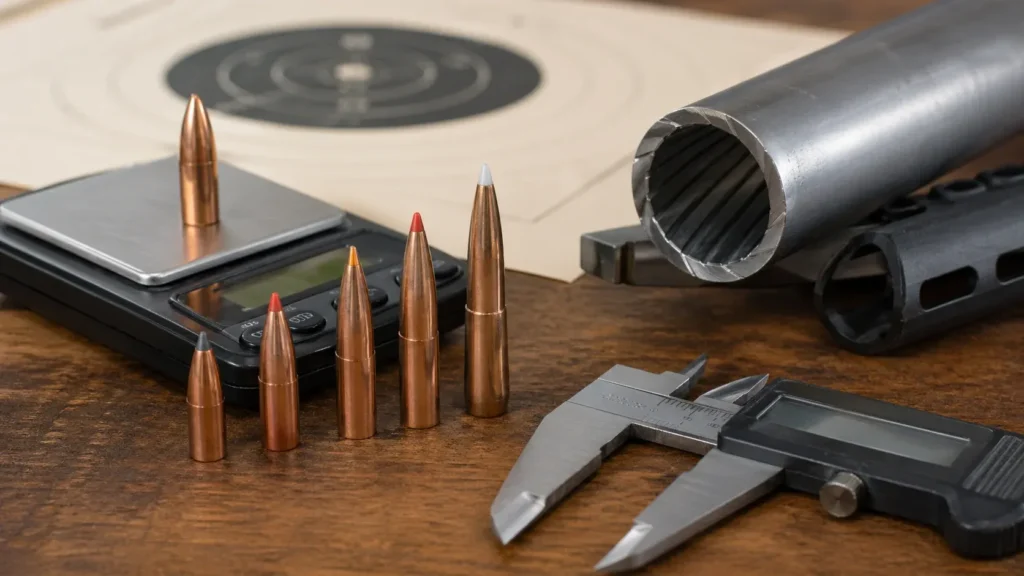
Many people rely solely on the weight of the ammunition. This is a common simplification. In reality, the physics of the process Depends on the bullet’s length. Heavy bullets are usually longer than light ones. It’s the length that determines how difficult it is to stabilize the projectile in flight. A longer bullet requires more energy to spin. Therefore, fast rifling is needed specifically for long and heavy ammunition.
There is a mathematical way to calculate this correspondence. The most famous is the Greenhill formula:
T = (K x D2} / L
In this formula, the letters mean the following:
T is the recommended rifling twist in inches.
K is the coefficient (150 for standard velocities).
D is the bullet diameter in inches.
L is the bullet length in inches.
The bullet length in this formula is in the denominator. This confirms a simple truth. The longer the projectile, the smaller the rifling twist should be. If you use a long bullet with a shallow twist, it will not achieve the desired spin rate. If you launch a short, light bullet through a twist that is too steep, excessive vibration may occur. This will also negatively affect the target.
It is important to remember what determines muzzle velocity Bullets. With shallower twist rates, it may be slightly higher due to lower resistance. But this difference pales in comparison to the problems with poor stabilization.
Conformance Table: Selecting a Cartridge for a Twist Rate
Below are data for the most popular calibers. These figures will help you narrow your search when choosing cartridges.
Caliber
Twist Rate
Bullet Weight (grains)
Typical Application
.223 Rem
1:12
40 – 55
Light bullets, varmint
.223 Rem
1:9
55 – 62
Universal step for most tasks
.223 Rem
1:7 / 1:8
69 – 80
Heavy bullets for long-range shooting
.308 Win
1:12
150 – 168
Classic hunting and training
.308 Win
1:10
168 – 200
Heavy Bullets for Sport and Mountaineering
Remember, this is just a starting point. Different brands use different ogive materials and shapes. This can change the behavior of the bullet even with the same weight.
What happens if you choose the wrong cartridge?
Mistakes in bullet weight and length selection lead to two main problems.
The first is understabilization. This occurs when using heavy bullets with a slow twist. The projectile lacks spin. In the air, the bullet begins to wobble. It can enter the target sideways, leaving oval marks. Accuracy is completely lost.
The second is overstabilization. This occurs when shooting light, short bullets with a fast twist. The bullet spins too much. Strongly. Any minor shape defect or shift in the center of gravity is amplified by centrifugal force. The bullet is pulled away from the target. At long ranges, such a bullet flies “nose up,” which increases air resistance.
Choosing the right cartridge allows you to realize the full potential of the barrel. This is the key to consistent hits and a long service life for your weapon.
How to test everything in practice at the shooting range
Theory is a good foundation. But each barrel has its own “character.” Even with the correct twist rate, two different rifles can shoot cartridges of the same weight differently. Manufacturing tolerances, surface finish, and even air temperature all play a role. Therefore, the only way to find your ideal performance is through practical shooting.
We recommend trying several cartridges that match your twist rate. Fire five-shot bursts at 100 meters. Only then will you see the true picture of accuracy.
Darwin Club has created all the conditions for such tests. Our instructors will help you take measurements and analyze your shot groups. We have equipment for professional gun cleaning and maintenance. After all, carbon deposits in the barrel can also distort your test results.
Brief Conclusions for the Shooter
Bullet length is more important than its weight when choosing a rifling twist rate.
The twist rate markings on the barrel should be checked manually with a cleaning rod.
Long bullets require a steep twist rate (e.g., 1:7), while short bullets require a shallow twist rate (e.g., 1:12).
An error in selection leads to loss of accuracy or “irons” on the target.
The final choice of cartridge is always made through comparative shooting.
Sign up for training at the Darwin Club shooting range. We will help you fine-tune your rifle-cartridge combination. and we’ll teach you to hit exactly where you aim.
More on this topic
26.12.2025
Collimator sight: what it is, how it works, and what it is used for
One of the most convenient optical devices is a red dot sight. It makes aiming much easier and faster, and also improves shooting accuracy. Today, red dot sights are used by military and police officers, as well as hunters, sportsmen, and civilian firearms owners.
In this expert article, we offer a
17.03.2026
What is a cartridge caliber — table and applications
One of the key parameters when choosing a weapon is the cartridge caliber. This characteristic directly affects the ballistics of ammunition, shooting accuracy, recoil, and the scope of application of the combat unit.
In hunting, sport, and military practice, it is the choice of caliber that determ
30.04.2026
Top 10 Legal Weapons for Self-Defense
When it comes to self-defense, it's important to understand that it's not about aggression, but about your own safety. In today's world, where unpredictable situations can arise anywhere, many are forced to consider available ways to protect themselves and their loved ones. It's important to remembe
26.12.2025
Collimator sight: what it is, how it works, and what it is used for
One of the most convenient optical devices is a red dot sight. It makes aiming much easier and faster, and also improves shooting accuracy. Today, red dot sights are used by military and police officers, as well as hunters, sportsmen, and civilian firearms owners.
In this expert article, we offer a
17.03.2026
What is a cartridge caliber — table and applications
One of the key parameters when choosing a weapon is the cartridge caliber. This characteristic directly affects the ballistics of ammunition, shooting accuracy, recoil, and the scope of application of the combat unit.
In hunting, sport, and military practice, it is the choice of caliber that determ
30.04.2026
Top 10 Legal Weapons for Self-Defense
When it comes to self-defense, it's important to understand that it's not about aggression, but about your own safety. In today's world, where unpredictable situations can arise anywhere, many are forced to consider available ways to protect themselves and their loved ones. It's important to remembe
Darwin Shooting Club— we do not sell firearms
Our club does not sell or resell firearms. We exist to teach safe, conscious, and responsible handling of firearms.We conduct training sessions, safety briefings, and promote a culture of informed firearm ownership.