Dominant Eye and Shooting: How to Determine It and What to Do with Cross-Dominance
29.05.2026Author: Charles Darwin
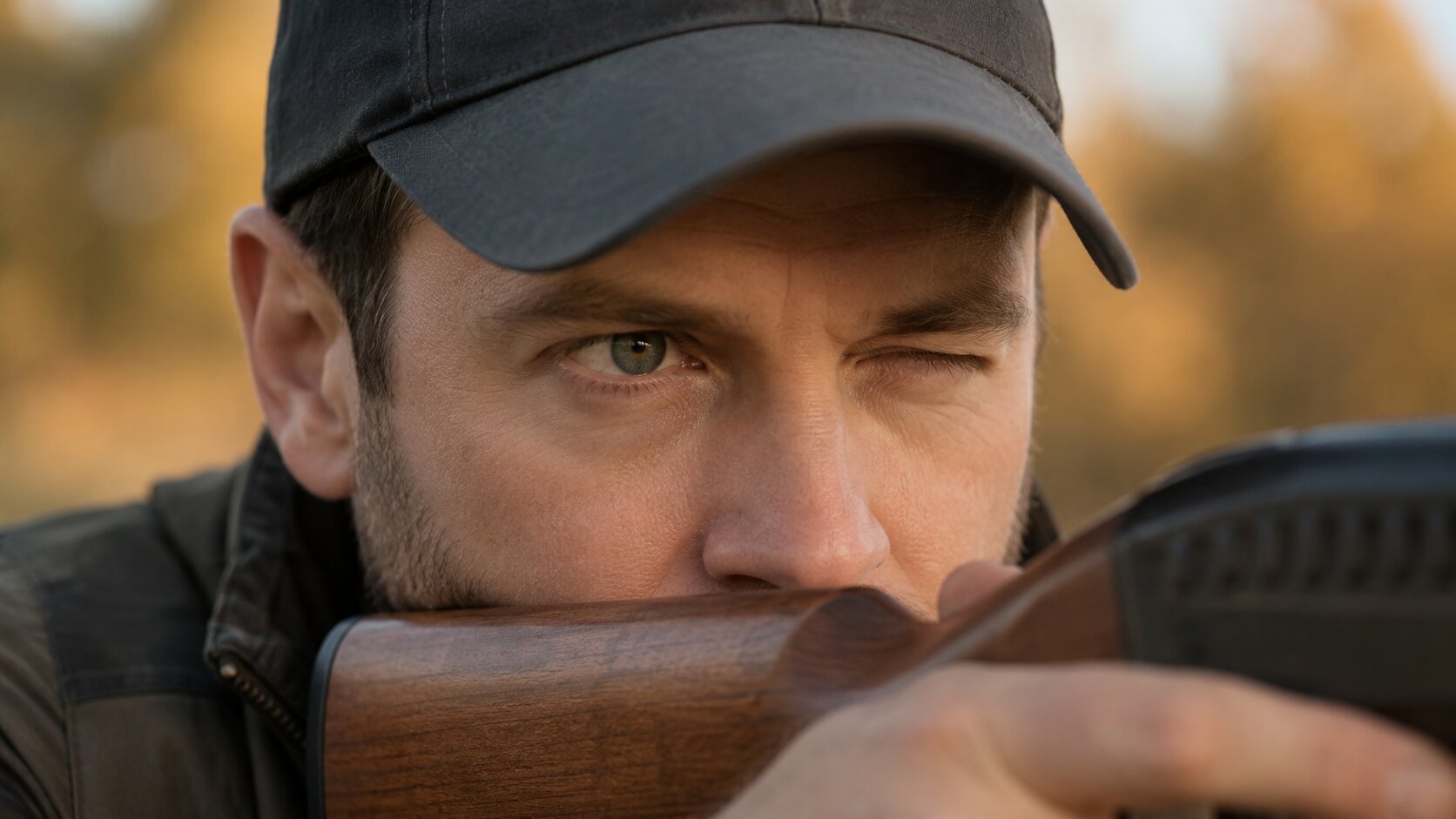
Shooting isn’t just about the weapon, technique, and reaction speed. Another important factor to consider when training is correctly identifying your dominant eye. The dominant eye is responsible for assessing the target’s position during shooting and establishing a line of sight.
In this article, we’ll examine in detail which eye should be closed when shooting a pistol and other weapons, how to adapt your aiming technique, and how to improve shooting accuracy.
What is a dominant eye and why is it important for a shooter?
The dominant eye is the visual organ used by the brain to receive a greater volume of visual information. Physiologically, this process is explained simply: with binocular (two-eyed) vision, the brain processes images from the dominant eye faster and more clearly than from the other.
When it comes to shooting, determining the dominant eye is the first and most important step in learning, as it is responsible for forming the aiming line.
The role of the dominant eye in shooting:
Necessary for forming the aiming line. To aim correctly, a novice shooter should learn to align the front and rear sights with the target seen by the dominant eye.
Responsible for shot accuracy. By identifying the dominant eye, a shooter will more easily and quickly master the skill of accurate shooting. Using the non-dominant eye when shooting leads to a significant shift in the aiming line, and the bullet will fly either to the right or left of the target.
Affects the speed of fire. Regular training with the dominant eye allows aiming to become automatic, since the brain does not need to waste time reorganizing and processing information received from the “secondary” visual organ.
Increases efficiency when working with optics. When shooting a weapon with a telescope sight, using the dominant eye minimizes the appearance of “shadows” (moons) in the sights.
How to Determine Your Eye Dominance When Shooting: Proven Methods
Determining your eye dominance when shooting is a key skill every beginning shooter should master, as it ensures accurate aiming and proper depth perception. This can be done in several simple ways, such as using the Miles or Port tests.
Miles Test: Step-by-Step Instructions
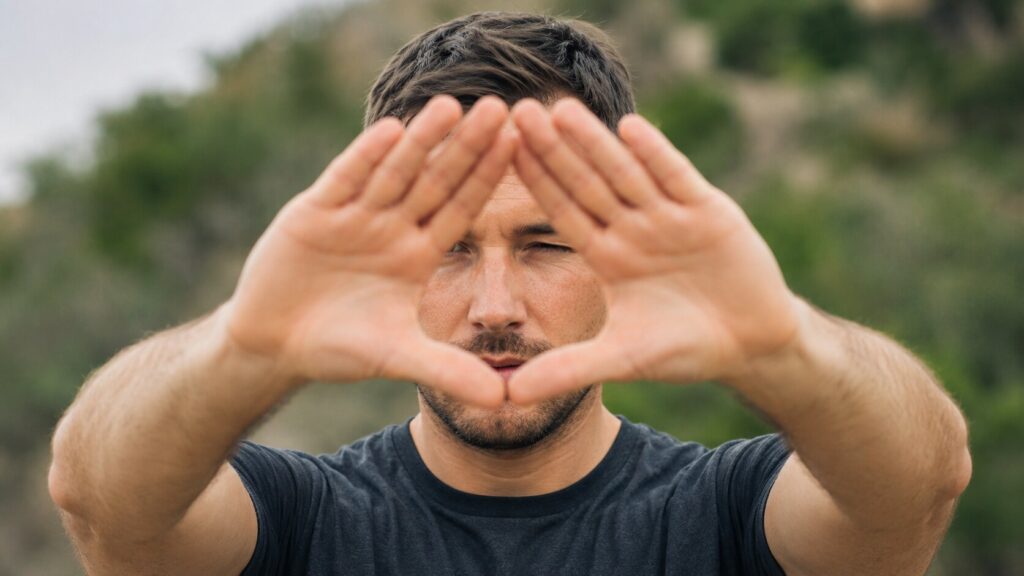
The Miles Triangle Test is one of the most common and accurate methods, allowing you to determine your dominant eye in just a few seconds.
Step-by-step instructions from Miles’s text for determining your dominant eye:
Preparatory Stage. Choose a small, distant object: for example, a clock or a point on the wall. The recommended distance is about 3-5 meters.
Formation of a conditional “sight”. Extend both arms in front of you. Place your palms together so that your thumbs and index fingers form a small gap in the shape of a triangle measuring 1-2 cm.
Target Fixation Stage. Look with both eyes open and focus on the chosen object. It is important to place the object precisely in the center of the triangular opening.
Test. Do not look away from the object and do not move your hands. Close and then open your left eye, then your right eye.
Miles’ Test Result: If your right eye is dominant, closing the left eye will keep the object in the center of the triangle, and closing the right eye will shift the target beyond it. If your left eye is dominant, closing the right eye will keep the object in the center, and closing the left eye will shift the target.
The Miles Test can also be performed in an alternative way. To do this, point the triangle at the target, then, keeping both eyes open, slowly bring your hands toward your face. Instinctively, your hands will stop opposite your dominant eye.
Alternative methods for testing at home
Alternative methods for determining your dominant eye include:
The Porta test. The method involves extending one arm, raising your thumb, and pointing it at a distant object with both eyes. Next, close each eye in turn, and the eye with the thumb remaining in place becomes your dominant eye.
Fingershot Test. Form a “pistol” with your hands and aim at a distant target. Close your right eye, then your left eye, one at a time. The eye that keeps the improvised target in place is your dominant eye.
Cross Dominance: What to Do If You’re Right-Handed and Your Dominant Eye is Left
If, based on your tests, you’ve determined that your dominant eye and dominant hand are the same (for example, you’re right-handed and your dominant eye is your right), congratulations, as this will allow you to master accurate shooting techniques more quickly and easily.
Situations where you’re right-handed and your dominant eye is your left (and vice versa) are called cross-dominance. The main problem is that cross-dominance significantly impacts shooting accuracy. Typically, the easiest way to resolve this situation is to consult with experienced instructors at shooting courses.
Which eye should I close when shooting, and is it necessary?
Professionals recommend learning to shoot with both eyes open right away, which ensures better visibility and distance perception. If this causes significant discomfort, closing the eye opposite the dominant eye is permissible.
Shooting with one eye closed: advantages and disadvantages
Shooting with one eye closed is considered a classic method of teaching shooting technique. However, in modern schools, beginners are increasingly being taught binocular aiming right away.
Shooting with one eye closed has a number of advantages and disadvantages.
Advantages of covering one eye when shooting:
It allows you to clearly align the front sight with the target and eliminates the double vision effect that often occurs in the initial stages of learning to shoot with both eyes.
It is easier to focus on the sights when information comes from only one eye.
With cross-dominance, closing one eye helps direct the line of sight correctly.
This method is often used in classic shooting with bullets at stationary targets at long distances, where a quick reaction to a change of sight is not required. environment.
Cons or why professionals recommend learning to shoot with both eyes open:
Closing one eye results in a significant loss of peripheral vision, which is especially important when hunting or in combat situations.
The loss of binocular vision leads to the brain having trouble determining the distance to a target and the volume of objects.
When you close your eyes tightly, the muscles of the face and neck are constantly tense, which, as a result, leads to rapid fatigue and reduced shooting accuracy.
When you close your eyes tightly, the pupil of the open eye can also reflexively constrict, thereby degrading image quality (especially at dusk).
Working with both eyes open: tips for experienced shooters
Binocular shooting allows you to preserve peripheral vision, correctly estimate the distance, and quickly transfer fire between targets.
Tips for experienced shooters:
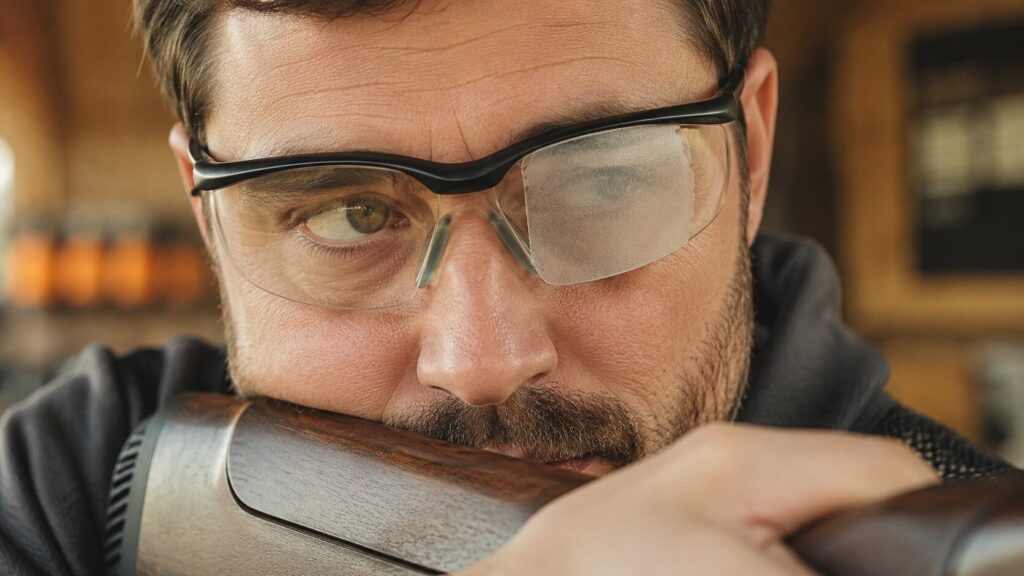
Even experienced shooters sometimes encounter a problem when switching to When shooting with both eyes open, the image appears double. To train yourself to binocular shooting, you can place a small piece of translucent tape on your safety glasses opposite the pupil of your non-dominant eye. This will train your brain to focus on the clear image of your dominant eye.
Use the “look ahead of the barrel” rule: when transferring fire, first move your gaze to the next target, then pull the gun up. This will eliminate tunnel vision and speed up the stabilization of the front sight on the target.
Practice dry-fire exercises at home to practice raising the weapon and aiming. Focus your vision on the front sight, ignoring the “phantom” image of the barrel. Over time, the brain will adjust and will no longer perceive the double image as interference.
How to Adapt Your Aiming Technique to Your Dominant Eye
Adapting your aiming technique to a cross-dominant eye (for example, a right-handed person with a dominant left eye) requires tricking the brain into using information from the desired eye without changing its usual “strong” hand. The main goal is Align the sights with your dominant eye.
Features of Pistol Shooting with Cross Dominance
When shooting in a classic stance with cross dominant sights, the front sight appears offset or split, due to the brain trying to process the image with both eyes.
When shooting a pistol, you can learn to shoot with your non-dominant hand, which is especially important if you carry a gun for self-defense. However, a simpler solution is to master a special aiming technique, in which the shooter tilts his head so that his dominant (left) eye is in line with the sight, and his cheek is Close enough to the right shoulder.
Furthermore, when shooting with one hand, experts recommend switching to the opposite shooting technique: tilting the pistol toward your dominant eye when shooting with your strong hand and maintaining the standard pistol position when shooting with your weak hand.
Additionally, you can use a red dot sight, which allows you to better focus on the target, not the front sight, and reduce the effect of double vision.
Working with long-barreled weapons: carbines and shotguns
When shooting with long-barreled weapons, the problem of cross dominance is more critical, since the technique requires a firm fixation of the head on the butt.
Perhaps the best way to cope with the problem of cross dominance in this case is to retrain to a left-handed stance. This is used… Many shooters use this technique, and over time, they achieve excellent accuracy. Additionally, a butt-shifting technique is used, whereby when shooting from the normal shoulder, the butt is shifted slightly toward the center of the chest, and the head is turned more to allow the dominant eye to look through the sights.
Sometimes, more drastic methods are warranted: covering the dominant (but not the aiming) eye immediately before shooting with a blindfold or special glasses.
Tips from Darwin Club Instructors for Improving Accuracy
Improving shooting accuracy requires a comprehensive approach, taking into account fundamental principles such as proper stance and grip, trigger pull, and aiming technique.
Darwin Club shooting instructors recommend the following for improving accuracy:
Practicing proper stance and balance. A stable stance is ensured by evenly distributed weight, a slight lean to the body to control recoil and maintain balance, and feet shoulder-width apart. It is also important to be able to properly position your body relative to the line between the front sight and the target.
Learn the correct grip of the gun, which will avoid vibration when shooting and distribute the roles of your hands. Your dominant hand should control the trigger, while your supporting hand should maintain stability.
Focus on the front sight when aiming. The rear sight and target will remain slightly blurred.
Practice a smooth trigger pull to avoid the gun shifting. The moment of the shot is also important—it shouldn’t surprise the shooter. After the shot, the trigger should be released slowly, until it clicks lightly. This will allow for a more accurate follow-up shot.
Regularly practice without ammunition at home. The goal of such training is Practice the correct movements and grip until they become automatic.
And most importantly, remember that shooting accuracy is not a gift or an innate quality, but the result of hard work and discipline.
More on this topic
11.03.2026
What is a sound moderator for weapons
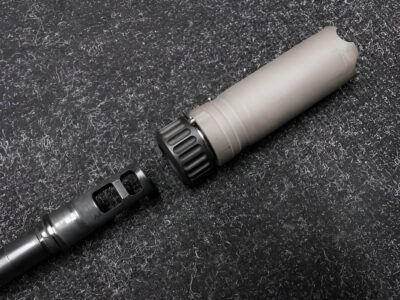
A silencer or sound moderator is a muzzle device for small arms, the main purpose of which is to reduce the sound of a shot. With a properly selected silencer, a weapon is considered virtually silent. Worldwide, it is regarded as such if the shot volume does not exceed that of an air gun. It is wort
30.04.2026
Rifle barrel twist: what it is and how to choose the right bullet weight for your rifling pitch
Shooters often face a frustrating situation. They've purchased an expensive rifle and high-quality optics. They've selected ammunition from a well-known brand. But instead of a neat group, the target displays a chaotic scattering of holes. At this point, many begin to look for a problem with the sco
05.05.2025
Top 10 Best Pistols
A pistol is a short-barreled, handheld firearm used to engage targets at distances of 50–70 meters.
Pistols are divided into several categories based on their purpose and design: military, civilian, sport, signaling, and hunting models. Structurally, pistols may be single-shot, automatic, or semi-a
11.03.2026
What is a sound moderator for weapons
A silencer or sound moderator is a muzzle device for small arms, the main purpose of which is to reduce the sound of a shot. With a properly selected silencer, a weapon is considered virtually silent. Worldwide, it is regarded as such if the shot volume does not exceed that of an air gun. It is wort
30.04.2026
Rifle barrel twist: what it is and how to choose the right bullet weight for your rifling pitch
Shooters often face a frustrating situation. They've purchased an expensive rifle and high-quality optics. They've selected ammunition from a well-known brand. But instead of a neat group, the target displays a chaotic scattering of holes. At this point, many begin to look for a problem with the sco
05.05.2025
Top 10 Best Pistols
A pistol is a short-barreled, handheld firearm used to engage targets at distances of 50–70 meters.
Pistols are divided into several categories based on their purpose and design: military, civilian, sport, signaling, and hunting models. Structurally, pistols may be single-shot, automatic, or semi-a
Darwin Shooting Club— we do not sell firearms
Our club does not sell or resell firearms. We exist to teach safe, conscious, and responsible handling of firearms.We conduct training sessions, safety briefings, and promote a culture of informed firearm ownership.