Coriolis Effect in Shooting: When Earth’s Rotation Affects a Bullet
12.10.2026Author: Charles Darwin
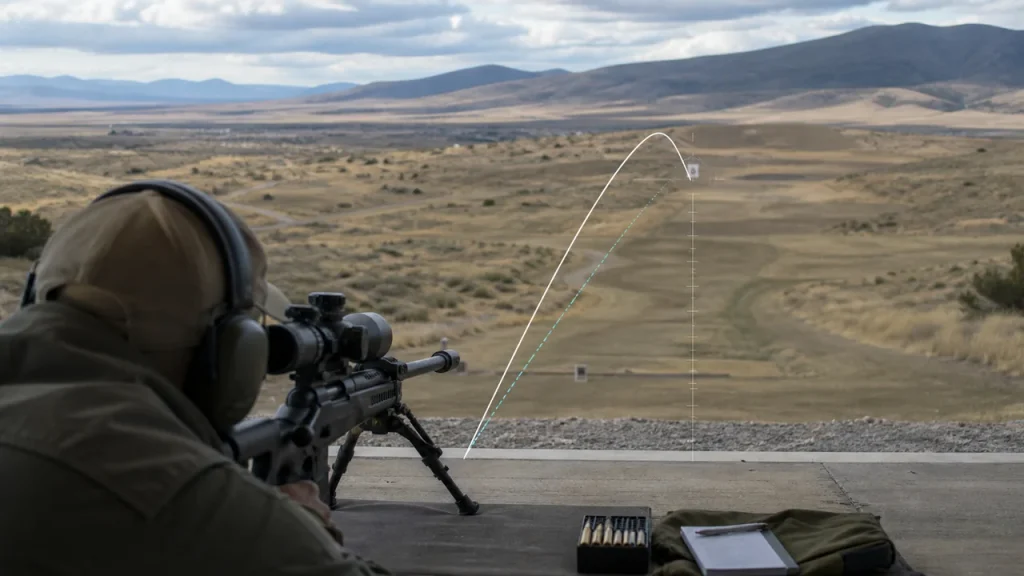
The Earth’s rotation can cause horizontal and vertical deviations in a bullet’s trajectory. In normal shooting, its effect is generally minor, but it becomes more significant at longer ranges. The magnitude and direction of the deviation depend on the geographic latitude, the direction of the shot, and the flight time.
The Coriolis effect, associated with the apparent curvature of a bullet’s trajectory relative to the rotating Earth, does not need to be taken into account for every shot. It can become significant during high-precision shooting at long and ultra-long ranges. When it comes to pistol shooting, hunting at medium ranges, or tactical combat, the Coriolis force is not taken into account because its effect is too small compared to the force of the wind and the weapon’s inherent inaccuracies.
In this article, we explain in detail what the Coriolis force is when shooting, in which direction it acts, and when it’s important to take it into account. The easiest way to gain the necessary knowledge and skills is from professionals, after first checking prices for shooting ranges in Kyiv.
What is the Coriolis effect, and why isn’t it important for every shot?
The Coriolis effect is a phenomenon that influences the motion of objects, but its interpretation depends on the reference frame. The reason is that the Earth rotates on its axis from west to east, and in a reference frame tied to its surface, the trajectory of a flying bullet appears curved. In physics, this is called an inertial effect, since it is related to the rotation of the reference frame.
The Coriolis effect is not significant for every shot for several reasons:
The planet’s rotational speed. The Earth has a low angular rotational speed—one rotation every 24 hours. Therefore, when shooting at short and medium ranges, the bullet’s deviation is too small.
The bullet’s flight time. As flight time increases, the effect accumulates and can become noticeable, especially at long ranges.
Other significant factors. When a bullet travels short and medium distances, factors such as wind, gravity, air temperature, and the bullet’s initial velocity are significant.
Snipers and artillery ballistics specialists take the Coriolis force into account when firing at long ranges. This is especially important when high accuracy is required.
How the Earth’s rotation affects a bullet’s trajectory
So, the main cause of the Coriolis effect is the Earth’s rotation. In a reference frame tied to the Earth’s surface, the bullet’s trajectory appears curved. This is an inertial effect, not a separate physical force pushing the bullet sideways.
Here’s how it affects the bullet’s trajectory:
Imagine a bullet flying over the rotating Earth: in an inertial reference frame, its motion is not curved by the planet’s rotation itself.
While the bullet is flying through the air, the Earth continues to rotate from west to east.
To an observer on Earth, it appears as though the bullet’s trajectory has changed and it has gradually veered off to the side.
Horizontal deviation: hemisphere, direction, and azimuth
The direction of horizontal deviation depends on the hemisphere, and its magnitude depends, among other things, on geographic latitude and flight time.
In the Northern Hemisphere, an object will always deviate to the right as it moves. In the Southern Hemisphere, the deviation occurs to the left as the object moves. At the equator, there is no lateral deflection during horizontal motion, but the vertical component may persist.
Recall that azimuth is measured clockwise from north (0°) up to 360°.
The Coriolis force changes the azimuth of the trajectory as follows:
In the Northern Hemisphere, the direction of deflection is to the right, and the azimuth—or clockwise shift—increases.
In the Southern Hemisphere, the direction of deviation is to the left relative to the direction of travel, and the azimuth decreases—that is, it shifts counterclockwise.
Vertical correction when firing east or west
When a bullet travels east or west, a vertical component of the Coriolis acceleration arises, known as the Etvös effect. It is directed upward when traveling east and downward when traveling west. At the same time, the horizontal deviation persists at most latitudes.
In practice, it works like this:
When traveling eastward, the bullet experiences a slight vertical upward deflection. Since the Earth rotates from west to east, when the bullet moves in the same direction, its linear velocity relative to the planet’s axis of rotation increases. Due to the Etvös effect, the trajectory passes slightly higher, all other things being equal.
When traveling westward, the bullet deviates slightly downward. When it moves against the planet’s rotation, its speed relative to the axis decreases, and the vertical component of the Coriolis acceleration points downward, so the trajectory will be slightly lower.
At close and medium ranges, this deviation is often small compared to other errors, such as wind and differences between rounds. At long ranges, the magnitude of the deviation depends on the conditions, so there is no universal value in centimeters.
What determines the magnitude of the correction: distance, flight time, and bullet velocity
The main parameters to consider when accounting for the Coriolis force are flight time, distance, and bullet velocity. Let’s examine each of these factors in detail.
Flight time is the main factor, since the deviation caused by the Coriolis effect accumulates over time. In a simplified model with constant acceleration, the deviation increases proportionally to the square of time, although the actual ballistic trajectory is more complex.
As for distance, it is related to time. A bullet flies longer over greater distances. At short and medium ranges, the correction is usually small compared to other factors. The effect becomes particularly noticeable at extremely long ranges.
The bullet’s velocity determines its flight time. At a higher muzzle velocity, all other things being equal, the flight time is reduced. Therefore, the deviation caused by the Earth’s rotation is usually reduced as well.
When Coriolis Force Must Be Taken Into Account
As we have already noted, the Coriolis force during long-range shooting can cause a noticeable bullet deviation; however, its significance depends on the conditions and the required accuracy.
At ultra-long ranges, the Coriolis effect must be taken into account, since the longer the bullet’s flight, the longer it remains in the air—and thus the Earth has time to rotate beneath it. At distances of around 1,000 meters or more, the deviation can be noticeable during high-precision shooting; however, it is impossible to specify its magnitude without taking into account latitude, direction, and trajectory parameters. As the range increases, the effect generally increases.
How to enter a correction in a ballistic calculator or sight
In modern ballistic calculators, the Coriolis effect is calculated and corrections are applied automatically. To do this, simply enable the corresponding option in the settings. The adjustment of the optical device depends on the type of sight.
Step 1—In the ballistic calculator menu, locate the “Enable Coriolis Effect” function and activate it.
Step 2—Enter the current geographic latitude of the firing location. Most smartphones and GPS devices automatically detect and display this information.
Step 3 – Specify the direction of fire toward the target in degrees—from 0° to 360°, where 0° is north and 90° is east. Alternatively, select the direction based on compass points if this option is available in the device’s interface.
Step 4—the calculator will compute the bullet’s vertical and horizontal deviations and add them to the total adjustments, which you will then need to apply to the sight’s adjustment drums.
Important: When adjusting the scope, it is essential to know how to calculate adjustments using MOA and MRAD.
Coriolis force, wind, drift, and shooter error: which has the greater impact
In practice, wind often affects shooting accuracy at medium and long ranges more than the Coriolis effect and drift (lateral deviation caused by the bullet’s rotation).
FACTOR
WHAT IT DEPENDS ON
LEVEL OF CRITICALITY
Wind
Wind speed and direction, firing distance
Maximum. An error in determining wind direction and speed of even 1–2 m/s at a distance of 800 m will most likely result in a miss.
Moderate. Directly determined by distance. Almost imperceptible up to 300–400 m; at 1,000 m, it can cause the bullet to deviate by 20–30 cm. Easily calculated using a ballistic calculator.
Coriolis effect
Geographic latitude, direction of fire.
Depends on distance, flight time, latitude, and direction of travel. The effect becomes more noticeable at long ranges, but there is no universal correction value.
Shooter errors
Preparation, practicing your stance, breathing, smooth trigger pull, and accounting for wind speed.
Critical. Errors in technique or incorrect wind calculations negate other high-precision adjustments.
Common myths and practical conclusions for the shooter
Myth 1: The Coriolis effect has a critical impact on every shot.
This is an incorrect statement. At close and medium ranges, its effect is usually negligible compared to the firearm’s grouping, wind, and shooter error. At long ranges, the effect’s contribution increases, but there is no universal threshold beyond which it becomes significant.
Myth 2: A bullet deviates only horizontally—to the right or left.
No, the Earth’s rotation can cause not only horizontal but also vertical deviation. The vertical component when traveling east or west is called the Etvös effect.
Myth 3: At the equator, a bullet is not affected by additional forces that deflect it vertically or horizontally
This is true, but only partially. Yes, indeed, there is no horizontal deviation to the right or left at the equator. However, it is precisely at the equator that the vertical deviation associated with the Etvös effect is greatest when traveling east or west, because the linear rotational speed is highest in this part of the planet.
Myth 4: The Coriolis correction can actually be calculated “by eye”
It is practically impossible to make accurate calculations visually, since the correction depends on factors such as latitude, the azimuth of the shot, the bullet’s initial velocity and its ballistic coefficient, as well as the bullet’s flight time. You should use a ballistic calculator, where you can enter precise data and obtain a ready-made value.
Myth 5: The Coriolis effect is the so-called “wind” caused by the planet’s rotation
The Earth rotates together with its atmosphere, which means the bullet is not deflected by a stream of air. The deviation occurs because the target itself shifts in space along with the Earth’s rotation while the bullet is flying toward it.
Let’s summarize. If a shooter is firing at close and medium ranges, the Coriolis effect usually has little impact. In this case, you should focus on the wind, aiming rules, and shooting skills. If the target is more than 1,000 meters away, be sure to use a ballistic calculator to enter the geographic coordinates and azimuth of the shot to improve accuracy.
Frequently Asked Questions
What is the Coriolis effect in simple terms?
The Coriolis effect is the sideways deviation of moving objects caused by the Earth’s rotation. In other words, to an observer, it appears as though the object has deviated from a straight trajectory, but in reality, while the object is traveling in a straight line, the Earth’s surface beneath it has shifted.
In which direction does the Coriolis force act during a bullet’s flight?
The direction of the Coriolis force during a bullet’s flight depends on which hemisphere of the planet the event occurs in. In the northern hemisphere, the effect is directed to the right relative to the bullet’s direction of travel; in the southern hemisphere, the Coriolis force is directed to the left relative to the direction of travel, and at the equator, there is no horizontal deviation.
At what distance does the Coriolis effect begin to influence shooting?
In practice, the Coriolis effect can become noticeable at long ranges. There is no single threshold: much depends on the conditions and the required accuracy.
Is it necessary to account for the Coriolis effect when shooting a pistol?
No, the Coriolis effect should not be taken into account when firing a pistol, since its influence is practically negligible at typical pistol ranges. This is all due to the physics of the shot itself and the short ranges at which short-barreled firearms are used: the bullet is in flight for only a short time, so technical factors such as accuracy, hand tremor, smooth trigger pull, and wind are the most important.
More on this topic
17.03.2026
Rules for aiming with small arms
Shooting with small arms is a popular sport, active recreation, and a useful skill that requires discipline above all else. But in addition to concentration and compliance with safety precautions, it is important to learn the rules of aiming.
How to prepare and master the rules of aiming, what mist
17.03.2026
What is a cartridge caliber — table and applications
One of the key parameters when choosing a weapon is the cartridge caliber. This characteristic directly affects the ballistics of ammunition, shooting accuracy, recoil, and the scope of application of the combat unit.
In hunting, sport, and military practice, it is the choice of caliber that determ
15.05.2026
Pump-Action Shotgun: A Detailed Guide to Design and Mechanism
The pump-action shotgun is considered one of the most recognizable and popular types of shotgun. Its main advantages are reliability, simple design, and quick reloading. Pump-action shotguns have long been used by hunters, sportsmen, law enforcement officers, and amateur shooters around the world.
17.03.2026
Rules for aiming with small arms
Shooting with small arms is a popular sport, active recreation, and a useful skill that requires discipline above all else. But in addition to concentration and compliance with safety precautions, it is important to learn the rules of aiming.
How to prepare and master the rules of aiming, what mist
17.03.2026
What is a cartridge caliber — table and applications
One of the key parameters when choosing a weapon is the cartridge caliber. This characteristic directly affects the ballistics of ammunition, shooting accuracy, recoil, and the scope of application of the combat unit.
In hunting, sport, and military practice, it is the choice of caliber that determ
15.05.2026
Pump-Action Shotgun: A Detailed Guide to Design and Mechanism
The pump-action shotgun is considered one of the most recognizable and popular types of shotgun. Its main advantages are reliability, simple design, and quick reloading. Pump-action shotguns have long been used by hunters, sportsmen, law enforcement officers, and amateur shooters around the world.
Darwin Shooting Club— we do not sell firearms
Our club does not sell or resell firearms. We exist to teach safe, conscious, and responsible handling of firearms.We conduct training sessions, safety briefings, and promote a culture of informed firearm ownership.