Pump-Action Shotgun: A Detailed Guide to Design and Mechanism
29.05.2026Author: Charles Darwin
The pump-action shotgun is considered one of the most recognizable and popular types of shotgun. Its main advantages are reliability, simple design, and quick reloading. Pump-action shotguns have long been used by hunters, sportsmen, law enforcement officers, and amateur shooters around the world.
In this article, we’ll take a detailed look at the design and operation of a pump-action shotgun, its advantages, shooting range features, and how to choose your first pump-action shotgun.
What is a pump-action shotgun and what makes it special?
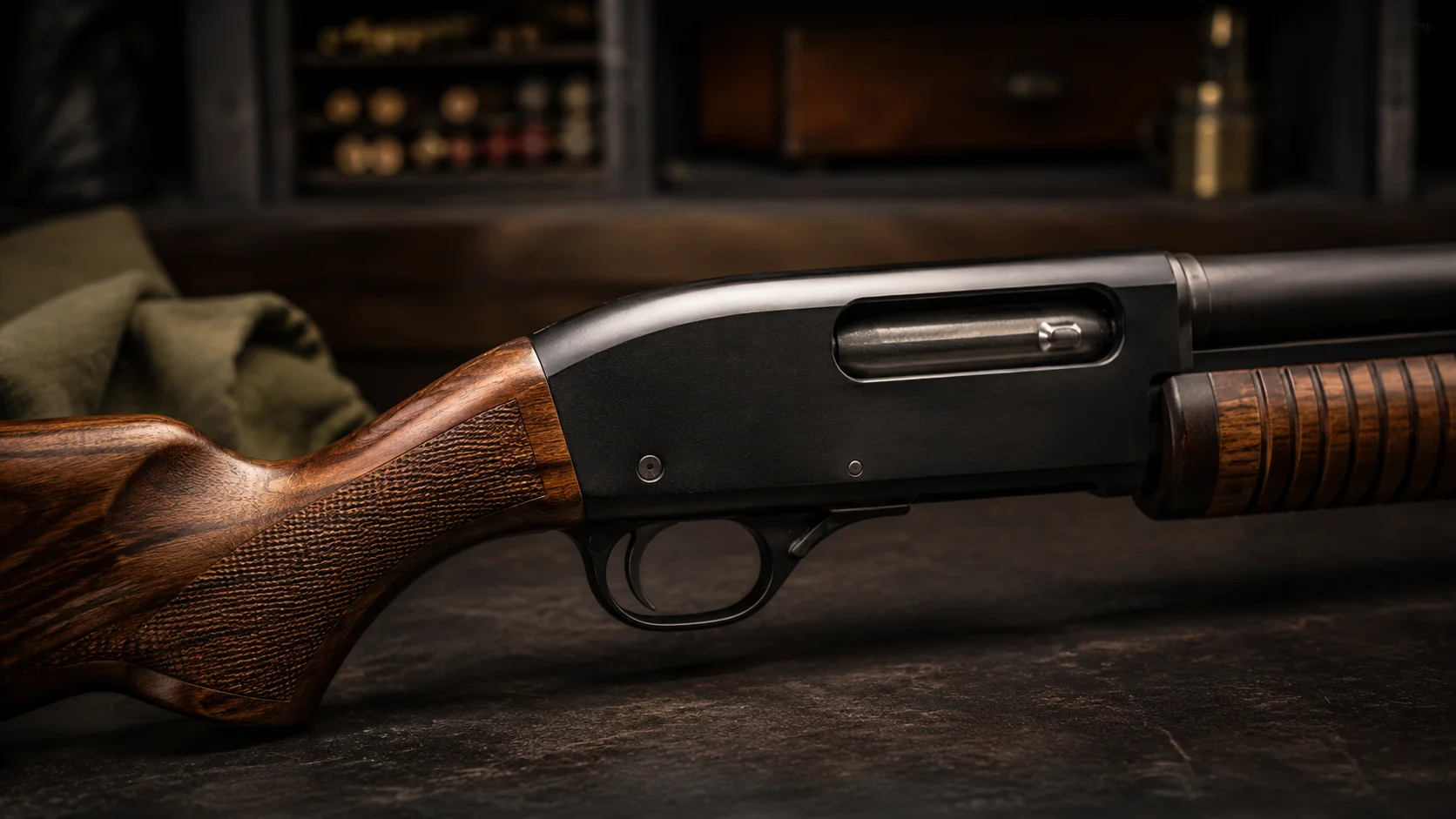
A pump-action shotgun is a firearm in which a sliding forend (fore-end) drives the bolt carrier, ejecting the spent shell and chambering a new cartridge.
This design is often found in shotguns and magazine-fed rifles. Pump-action rifles and grenade launchers also exist. The mechanism is considered faster than, for example, double-barreled shotguns, since you don’t need to remove your hand from the handle to reload until the magazine is empty. This type of reloading is called a sliding forend.
Pump-action shotguns are used in a variety of applications. First and foremost, they are used for hunting various game (birds, hares, and large mammals). Secondly, they are effective for self-defense and as a service weapon. Furthermore, pump-action shotguns are suitable for recreational shooting due to their reliability, ease of use, and quick reloading.
It’s worth noting that pump-action shotguns are relatively inexpensive. This affordable price has made them popular in urban environments. Demand is also due to the ability to use various types of cartridges, including self-loading ones.
Main Components and Mechanisms of a Pump-Action Shotgun
The structure and operating principle of a pump-action shotgun are simple yet sophisticated. Each component performs a specific task.
Barrel and Receiver: The Basics of the Design
The barrel is the main structural element; the shot is fired through it. Smoothbore pump-action shotguns have a smooth bore, but they can be equipped with interchangeable chokes, which allow for adjustment of firing accuracy. To choose a shotgun, it’s important to know its basic characteristics. Barrel length determines the pump’s intended purpose. Tactical models are equipped with short barrels, while hunting models are equipped with long ones.
The receiver is essentially the body of the shotgun, housing all the key components and mechanisms.
The Forelock and Bolt Mechanism: The Heart of the Pump-Action System
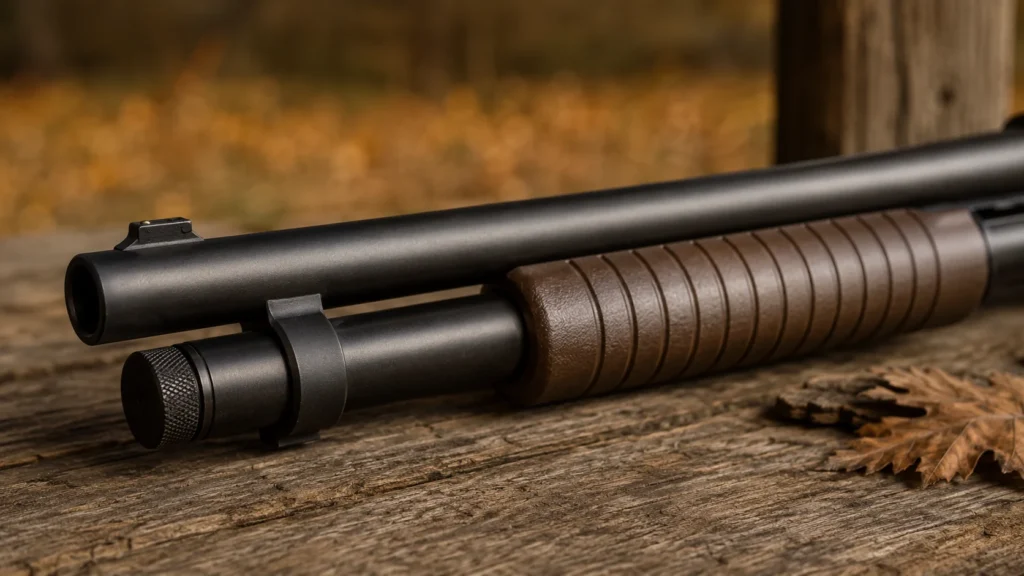
The forelock is the movable front part of the stock of a pump-action shotgun, whose primary function is to reload. The back and forth movement of the forend performs several operations, namely ejecting the spent cartridge, cocking the trigger mechanism, feeding a new cartridge from the magazine, and closing the bolt.
The bolt, in turn, is responsible for closing the barrel in a pump-action shotgun and ejecting the spent cartridge. It is connected to the forend via a system of rods.
Underbarrel Magazine Tube and Cartridge Feed System
Most pump-action shotguns are equipped with a tubular magazine located under the barrel. Cartridges are loaded into it sequentially. Magazine capacity depends on the type of pump-action shotgun and the length of the tube. On average, magazines hold 4-8 rounds. After each movement of the forend, the magazine spring feeds the cartridges into the feed tray.
The trigger mechanism is the part of the structure that controls the firing of the shotgun. When the forend is moved, the mechanism is cocked and the weapon is ready for action. Almost all modern pump-action models are manufactured with a safety system that blocks the trigger.
How It Works: Step-by-Step, From Loading to Firing
Next, we’ll take a closer look at how a pump-action shotgun works.
It’s important to understand that it operates using a mechanical reloading mechanism, which the shooter performs independently. The magazine is loaded one after another, using a spring to press the cartridges. To chamber the first cartridge, the shooter moves the forend back and forth. At the same time, the bolt opens, the trigger mechanism cocks, and a cartridge is fed from the magazine into the chamber, and then into the chamber.
Pressing the trigger fires the shot. To continue firing, the forend must be moved again. As the bolt moves back, the spent cartridge case containing the cartridge falls out, and a new cartridge is loaded into the barrel under the force of the spring. The forward movement of the forend feeds a cartridge into the chamber, and the bolt closes. This mechanism allows for both single shots and bursts of fire.
Advantages of a Pump-Action System for the Shooter
Pump-action guns offer a number of advantages, the most important of which are reliability and the ability to use different types of ammunition, as well as safety and ease of maintenance.
Reliability and versatility of ammunition
A pump-action shotgun is suitable for use with various types of ammunition:
With various propellant loads, since the pump does not require the energy of powder gases and recoil for reloading. It works equally well with powerful cartridges, as well as with training and sporting ammunition.
With non-standard cartridges – Compatible with traumatic, flare, and gas ammunition, which have too little energy for automatic operation.
With cartridges of varying quality, due to their lower sensitivity to crimping and material.
The pump-action shotgun’s simple design ensures its smooth operation even in challenging situations. Pump-action shotguns are more resistant to dirt and moisture than complex automatic and semi-automatic weapons. If a misfire occurs, a single movement of the forend is enough to eject the cartridge and retrieve the next one. Because the shotgun has a simple design and a minimum of fragile and small parts, it can last a very long time with proper care.
Ease of Maintenance and Safety
Pump-action shotguns are easy to clean and less sensitive to contamination from powder dust and soot. Frequent and meticulous cleaning of all components is not required for proper operation.
In terms of safety, a pump-action shotgun chambers a cartridge only after the shooter makes a deliberate movement of the forend. This means the risk of an accidental discharge during sudden movement or a fall is minimal. The shooter also always knows whether the weapon is loaded by the position of the forend. The design allows the cartridge to be kept in the magazine rather than in the barrel, allowing the weapon to be ready for action in a matter of seconds.
The magazine can be reloaded very quickly while firing. The characteristic sound of the fore-end jerking often acts as a deterrent and has a positive psychological effect, when even a difficult situation can be resolved without the use of force.
Features of Pump-Action Shooting in a Shooting Range
Shooting a pump-action shotgun in a shooting range in Kyiv, in addition to general safety rules, has several technical features, unlike pistols and semi-automatic shotguns:
When working with the fore-end, reloading should be done with a vigorous movement towards and away from you to avoid such unpleasant consequences as under-chambering a cartridge or failure to eject the shell.
Pump-action shooting has a clear alternation of cycles that must be practiced until automatic: firing – reloading – aiming – Shot.
Since the fore-end must be constantly moving, the aiming line will be disrupted after each shot. Therefore, it is crucial to learn how to quickly return the gun to the target.
Before firing, make sure the safety is off.
Additionally, instructors at the range practice reloading the magazine during pauses in shooting, using the “shoot and load” principle.
Pump-action shotguns typically have noticeable recoil, so it is important to learn how to properly place the buttstock in your shoulder.
Failure to fully return the fore-end is a common cause of delays. If there is a delay or misfire, place the gun down and wait for the instructor. In this case, it may be necessary to have the pump-action shotgun tested at a gunsmith’s workshop.
To summarize, the most important thing when shooting a pump-action shotgun at a shooting range is to maintain discipline, practice hand-eye coordination, and work rhythmically with the forend.
Advice from Darwin Club instructors on choosing your first shotgun
When planning to buy your first pump-action shotgun, pay attention to the recommendations from Darwin Club instructors:
Caliber. The 12 gauge is considered the most versatile, as it offers a wide selection of ammunition and good stopping power. For beginner shooters of smaller builds, the 20 gauge is more suitable, as it has less recoil than the 12 gauge.
Purpose. If the primary purpose of the purchase is self-defense or tactical use, buy a pump-action shotgun with a short barrel (approximately 510 mm). For hunting, it’s better to choose a long barrel with interchangeable choke tubes.
Equipment. For mastering basic shooting techniques, a gun with a classic configuration without additional accessories is suitable. Later, we recommend purchasing those elements that will truly improve shooting comfort and effectiveness.
Buying a pump-action shotgun is just the first step. The most important thing is to learn how to use it, which is easiest to do by enrolling in a shooting course. At the shooting range, you can gain basic shooting skills, learn to confidently and correctly hold the weapon, and practice all the movements until they become automatic.
More on this topic
15.03.2026
Top 10 Legal Weapons for Self-Defense
Shooting at a shooting range has long ceased to be just a pastime. Today, it's a fully-fledged way to develop concentration, discipline, and accuracy. While the choice was previously severely limited to certain gun models, more and more shooting clubs are now using popular carbine brands. These type
17.03.2026
What is a cartridge caliber — table and applications
One of the key parameters when choosing a weapon is the cartridge caliber. This characteristic directly affects the ballistics of ammunition, shooting accuracy, recoil, and the scope of application of the combat unit.
In hunting, sport, and military practice, it is the choice of caliber that determ
30.04.2026
Rifle barrel twist: what it is and how to choose the right bullet weight for your rifling pitch
Shooters often face a frustrating situation. They've purchased an expensive rifle and high-quality optics. They've selected ammunition from a well-known brand. But instead of a neat group, the target displays a chaotic scattering of holes. At this point, many begin to look for a problem with the sco
15.03.2026
Top 10 Legal Weapons for Self-Defense
Shooting at a shooting range has long ceased to be just a pastime. Today, it's a fully-fledged way to develop concentration, discipline, and accuracy. While the choice was previously severely limited to certain gun models, more and more shooting clubs are now using popular carbine brands. These type
17.03.2026
What is a cartridge caliber — table and applications
One of the key parameters when choosing a weapon is the cartridge caliber. This characteristic directly affects the ballistics of ammunition, shooting accuracy, recoil, and the scope of application of the combat unit.
In hunting, sport, and military practice, it is the choice of caliber that determ
30.04.2026
Rifle barrel twist: what it is and how to choose the right bullet weight for your rifling pitch
Shooters often face a frustrating situation. They've purchased an expensive rifle and high-quality optics. They've selected ammunition from a well-known brand. But instead of a neat group, the target displays a chaotic scattering of holes. At this point, many begin to look for a problem with the sco
Darwin Shooting Club— we do not sell firearms
Our club does not sell or resell firearms. We exist to teach safe, conscious, and responsible handling of firearms.We conduct training sessions, safety briefings, and promote a culture of informed firearm ownership.